October 25, 2026 — Global 45° Weekly Calibration: Multi-Sector Intelligence, Global Ripple Effects & Strategic Drift
An evidence-led assessment of physical reality, geopolitical change, markets, technology, energy, health, resources and resilience—and how shocks propagate across industries, borders and populations.
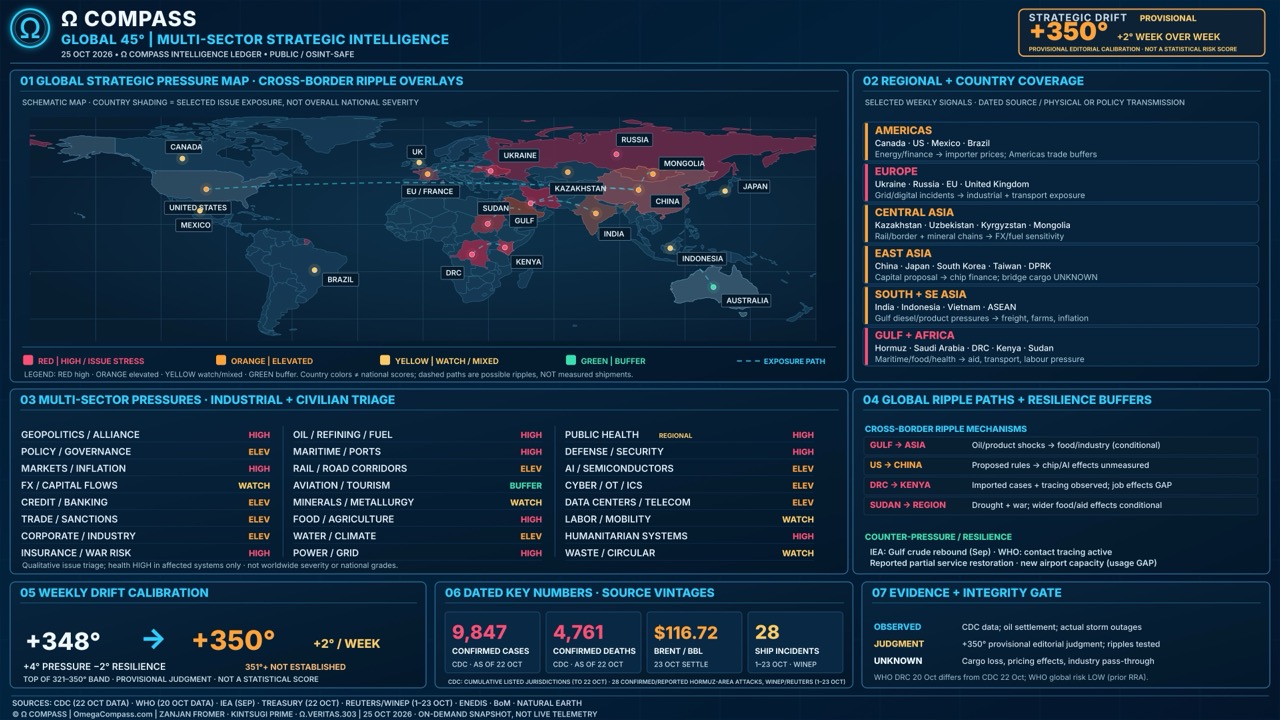
Executive orientation
Analytic judgment — upper multi-theater coupling remains the defensible description. The reporting window adds documented stress in maritime security, energy and refining inputs, Ukraine’s power and Russian digital-service infrastructure, African epidemic response, food/humanitarian systems and strategic technology finance. Meanwhile actual Gulf export recovery, functioning institutions, public-health contact tracing and new airport infrastructure illustrate nonuniform resilience.
The weekly finding is elevated pressure with upward signals in interconnected physical and financial systems, not an established globally synchronized collapse. A rise in incident reports does not by itself establish lost cargo; a rise in oil futures does not measure retail inflation; ministerial policy proposals do not prove capital withdrawal. The most strategically relevant exposures now link Gulf tanker routes to Asian refiners; Black Sea security to grain buyers and food-importing economies; drought and conflict to Sudan’s food/aid systems; American capital controls to the China-facing technology value chain; and Central African outbreak control to mobility, care capacity and workforce resilience.
References: IEA October oil market assessment; IMF October outlook; WHO outbreak report.
Weekly drift continuity & decision gate
Continuity record · Horizontally scroll the table on mobile.
| Reference | Recorded reading | Evidence / permitted interpretation |
|---|---|---|
| February 25, 2026 | +298° | Inherited public reference; primary L1/L3 stabilization test. |
| October 4 | +332° original / +336° later comparator | The archived original October 4 report says +332°; October 11 and subsequent retrospectives cite +336°. Provenance variance unresolved; preserve both rather than silently overwrite the original. |
| October 11 | +343° | User-provided last-published comparator. |
| October 18 | +348° PROVISIONAL | Editorial comparative judgment from prior report; no independently fitted algorithm. |
| October 25 | +350° PROVISIONAL | +2° comparative editorial movement: +4° new pressure clusters, −2° offsets. Upper Multi-Theater Coupling; no demonstrated 351°+ transition. |
Decision rule: assess physical/operational reality (Layer 1) together with economic/financial plumbing (Layer 3): actual throughput, outages and repair pace versus insurance, credit, oil-product deliveries and payments. A diplomatic statement (Layer 2) cannot by itself neutralize persistent physical or financial stress. A modest within-band increase can follow an evidence-labeled comparative bridge; promotion to 351°+ requires stronger, independently documented synchronization of physical corridor interruption, infrastructure failure, funding/payment dysfunction and insufficient recovery capacity. A downward revision requires meaningful stabilization in Layers 1 and 3 across a relevant period. February 25 baseline · Public degree bands
Category interpretation: Under the published Ω Compass rubric, the 321°–350° range is the Multi-Theater Coupling Phase, while 351°–400° denotes a separate System Breakpoint Envelope. At +350°, the October 25 judgment is on the current phase’s upper boundary—not inside the next band. These are editorial analytical categories, not a physical rotation, a probability of world war, or an independently calibrated statistical index. The higher envelope is not established in this edition.
Continuity variance: The original October 4 article archived in the calibration MLOps ZIP displays +332°, while October 11 calls its October 4 comparator +336°. Both readings remain visible as a provenance discrepancy. The proposed +350° October 25 judgment uses the October 18 +348° comparator directly; it does not silently interpolate or repair the October 4 record.
October 25 provisional degree bridge — +348° to +350°
Calibration qualification: PROVISIONAL EDITORIAL CALIBRATION · NOT A STATISTICAL RISK SCORE. The +4° pressure and −2° resilience contributions are disclosed comparative judgment units, not measured probabilities; 351°+ remains unestablished.
Decision: increase the provisional Global 45° drift reading by +2°. The upward adjustment reflects additional physical and market stresses in the reporting week, partially counteracted by observed functioning routes, containment activity and restoration. This follows the historical practice of making comparative editorial judgments; it does not imply the system uses a validated event-to-degree statistical model.
The following clusters are deliberately deduplicated: a shipping incident, associated risk-premium concern and oil-price reaction form a linked exposure, not independent evidence of three distinct corridor closures. Numbers below are public editorial contribution units, not causal-effect estimates or proprietary internal model weights.
| Pressure / counter-signal | Editorial adjustment | Evidence and interpretation boundary |
|---|---|---|
| Gulf maritime security and oil repricing | +2° | Reported October vessel-attack intensity and October 23 Brent settlement at US$116.72/bbl strengthen the combined physical-risk and market-pricing signal. Reported attacks do not independently establish matched cargo losses, worldwide refinery shutdown or destination retail inflation. Attacks · Oil price |
| Physical electricity and digital-system interruptions | +1° | Reported Ukraine energy attacks and October 23 French storm-related electricity/transport outages create fresh operational disruption. Different regions and causes remain distinct: there is no inferred command linkage, and reported outages must not be equated with permanent capacity loss. Ukraine · Enedis |
| Cross-border Ebola outbreak response pressures | +1° | WHO and CDC reports describe continued DRC transmission and confirmed cases outside the DRC, including Kenya and imported-case reporting for Nigeria, with different observation cutoffs. This supports geographic and healthcare-system pressure, not a claim of generalized international community transmission. WHO · CDC |
| Continuing Gulf crude exports and route functionality | −1° | IEA’s October assessment documents September recovery in crude movements and continued significant flows through Hormuz. This offsets an assumption of complete Gulf closure, although product-level and ship-by-ship constraints persist. IEA |
| Health containment and partial service restoration | −1° | Documented contact tracing and isolation activity, plus reported partial digital-service restoration, demonstrate some response capacity. They neither prove the Ebola outbreak has ended nor certify full restoration of the impacted digital and physical systems. WHO · AP |
Why not +351°? Neither these events nor their potential downstream ripple paths establish contemporaneous, sustained cross-system breakdown of cargo delivery, major infrastructure, credit/payments and recovery capacity. Upstream stress and a prospective chain of economic effects are not proof all links have materialized. Similarly, the U.S.–China investment proposal, Sudan hunger forecasts and prospective AI bottlenecks receive no additional degree units here until implementation and measured impacts are documented.
Public multilayer drift: explainable without revealing proprietary mechanics
Published framework lenses · Horizontally scroll the table on mobile.
| Public layer | What is assessed | Falsifier / de-escalation clue |
|---|---|---|
| Physical and operational reality | Violence; ports; assets; health facilities; actual cargo; outages; restoration | Restored service, recovered capacity and falling incident rates |
| Diplomatic / narrative theater | Treaties, summits, rhetoric, legislation and government signals | Implementation and compliance rather than promises |
| Financial / economic plumbing | Insurance; FX; rates; cargo contracts; inventory; credit; households | Sustained lower delivered costs and functioning credit |
| Alliance and institutional geometry | Coalition behavior, cross-alignment hedging, bilateral ties | Actions and transactions contradicting assumed alignment |
| Information, uncertainty and attribution | Source provenance, media claims, independent checks, disinformation risks | Credible original data, identified source dependencies |
| Industrial, technology and resource substrate | Compute, semiconductors, energy, minerals, water and capital | Commissioned, utilized and sustainably supplied capacity |
The publicly explainable method uses a non-linear, multilayer chessboard perspective: national decisions can shift on different timelines, and the effects travel through suppliers, processing facilities, infrastructure nodes and end markets. A policy layer can appear calmer while physical damage and industrial or financial costs worsen. The conceptual multilayer framework predates this issue; its industrial/technology extension is additive rather than falsely attributed to the earliest iteration.
Regional and transnational operating picture
Regional/theater cross-border status · Horizontally scroll the table on mobile.
| Theater / cross-border system | Observed status through this issue | Ripple pathway / critical gap |
|---|---|---|
| Gulf / Hormuz / Arabian Peninsula | HIGH: October shipping incident counts attributed to external trackers; Saudi strike claims and counterclaims; no per-vessel verified cargo-loss census. Source | Maritime security → rates and insurance → crude/product imports → Asian factories, agriculture, transport. Actual delivered volumes remain separate. |
| Ukraine / Russia / Black Sea | HIGH: continuing grid attacks and reported Russian digital-service disruptions. Source · AP | Electricity and data services → payment services, digital commerce, grain movements; attribution/asset-condition and ongoing throughput need individual confirmation. |
| EU / UK / North Atlantic | MIXED: Storm Austen observations and Storm Boelo wind warnings (forecast). Met Office | Grid, rail, ferry, port and insurance possible disruption; forecast ≠ observed damage. |
| DRC / East-Central Africa / Kenya / Nigeria | HIGH HEALTH: WHO October 23 BVD report; CDC later reporting vintage. WHO | Outbreak transmission, clinical staff, aid, border surveillance; no blanket global spread inference. |
| Sudan / Horn / Red Sea food routes | HIGH HUMANITARIAN: drought/aid access compounding conflict. Reuters | Agricultural output, livestock, nutrition, migration and port deliveries; future hunger additions are forecasts. |
| US / China / semiconductor ecosystem | POLICY STRESS: proposed Treasury controls and Chinese objection; no new final rule demonstrated. Treasury | Capital screening → research partnerships, fabs, biotech and export licensing; actual financing not measured. |
| China / DPRK / Northeast Asia | CONDITIONAL: Kim Jong Un visit using new border bridge. Reuters | Physical crossing and diplomacy do not certify truck counts, goods, legal status or commercial flows. |
| Japan / Korea / Taiwan / ASEAN | STRUCTURAL: chip-memory and manufacturing interdependence; no complete regionwide weekly production census. | Chips → compute → grid and cooling → industry; national export data and foundry yields required. |
| India / Indian Ocean / South Asia | IMPORT EXPOSURE: Gulf shipping, crude, LNG, fertilizers and foreign exchange; fresh national invoice series not compiled. | Transport premium → energy/import costs → agriculture and consumer inflation, with variable domestic buffering. |
| Mongolia / China / Russia / Central Asia | BUFFERED BUT EXPOSED: high reserves alongside commodity concentration, bank FX risks and refined fuel logistics. BoM | Copper/coal receipts → FX/budget; imported refined fuel → rails and prices; third-neighbor technology is opportunity, not realized output. |
| Australia / Pacific and Asian aviation | CAPACITY ADDITION: Western Sydney passenger opening October 25. Reuters | New aviation operating option; design capacity ≠ utilization, cargo exports, jobs or GDP realization. |
| Americas / commodity exporters | ASYMMETRIC: IMF slowdown/inflation forecasts plus commodity terms-of-trade differences. IMF | Oil importers and exporters, copper producers and food producers face unlike net effects; country-specific volumes needed. |
| Western Balkans / European institutional alignment | POLITICAL: Serbia election underway October 25; no independently verified result in this issue. | Policy and finance risk changes only if a confirmed political result becomes implementation. |
Cross-industry, cross-sector and transnational ripple register
Logic: Every material issue moves through a bounded chain of trigger → physical transmission → commercial and regulatory channels → observed effects → alternative explanations. A downstream arrow describes a testable mechanism, not automatically a realized consequence. Each named issue is counted once even if it touches multiple sectors.
Evidence-ladder convention: OBSERVED denotes a bounded source-dated report; CONDITIONAL denotes plausible but unverified second- or third-hop cross-industry outcomes. Kenya importation/contact tracing, French power outages and Treasury’s proposed rule are first-hop observations; employment collapse, food-price pass-through, national trade displacement or implemented investment bans require separate original measurements.
Cross-system causal trace · Horizontally scroll the table on mobile.
| Trigger / node | Possible transmission | Observed evidence | Next measured indicator | Disposition |
|---|---|---|---|---|
| Hormuz security and vessel incidents | Carrier routing → war-risk premiums → refiners → freight → food and consumer prices | Incident reports are sourced; IEA observed recovered Gulf crude exports in September | Actual weekly voyage IDs, unloading, freight invoices and diesel retail prices | HIGH exposure; realized downstream GAP |
| Middle East diesel imbalance | Less product/LPG export availability → Asia/Europe refiners and trucking → agriculture and wages | IEA October report separates crude rebound from continued middle-distillate shortages | Actual country product imports and local pass-through | HIGH upstream; varied impact |
| Black Sea conflict / Ukraine winter grid | Strikes and power loss → rail/port/mill function → grain movements → African and Asian importers | Reported strikes and infrastructure degradation | Grid operator repairs, port tonnage, country grain receipts | HIGH risk; attributed output |
| Digital infrastructure strikes inside Russia | Data-center asset damage → cloud interruption → banking/retail/AI research | AP reports service disruptions and partial restoration | Independent operator outage windows, loss of compute, rerouted capacity | REPORTED / forensics GAP |
| France cold-chain cyber legacy | Connected controls → temperature exposure → perishable losses → waste → insurance claims | Prior reported event with conflicting affected-outlet counts | Operator/insurer counts and independent incident attribution | CONTINUITY / scope variance |
| Sudan rainfall + conflict | Observed rain deficits + conflict/access barriers → possible harvest, prices, displacement, aid-delivery effects requiring dated outcome data | Past rainfall observations and June IPC baseline; WFP future estimates | October harvest receipts, aid delivered, updated IPC | ACTIVE / actuals GAP |
| DRC BVD and Kenya/Nigeria imports | Observed imported cases and linked Kenya cluster → tracing/isolation; potential staffing and cross-border service effects unmeasured | WHO dated cases/contact categories and later CDC snapshot | Country same-date line lists, treatment personnel, supplies | REGIONAL HIGH health pressure / downstream economic effects GAP |
| US–China investment policy proposal | Legal proposal → due diligence → capital allocation → fab, AI, biotech suppliers | U.S. notice issued; Chinese ministry objects | Final rule, affected deals, actual capital movement | PROPOSAL / implementation GAP |
| New Yalu bridge connectivity | Border opening → possible customs access → freight/energy trade → industrial supplies | Diplomatic visit and physical crossing reported | Customs tonnage and truck operations, permits | ACCESS / cargo unknown |
| Western Sydney airport | Operational passenger service → tourism/business access → supply logistics and employment | Opening reported; cargo already begun earlier | Observed departures, passenger count, tonnage and salaries | OPEN / outcomes unknown |
| Storms in Europe | Confirmed winds and forecast extremes → grid/rail shutdowns → insurance and food supply | Met Office storm measurements/warnings | Operator minutes without power, cancelled trains, claims | FORECAST vs OBSERVED split |
| Mongolia reserves and mineral exports | Export FX inflows → reserves/credit → resilience; diesel imports → transport CPI | BoM September reserve/inflation observations | October import stock cover, shipments, real wages | MIXED / lag uncertain |
| AI buildout and investment markets | Accelerators/HBM → grids → water/cooling → project finance → business output | Public capex/industrial dependencies; IMF upside/downside scenario | Completed MW, installed compute, sold services and net profit | STRUCTURAL / no verified aggregate impact |
| Minerals refining and substitutions | Mine licence → concentration/separation → metal purity → components → importer dependencies | Strategic projects and investment announcements vary | Commissioned plants, physical qualified products, offtake | LONG-ARC opportunity / output GAP |
Multi-sector intelligence coverage & analytical capabilities
Coverage is adaptive rather than a fixed sector count. Source availability, materiality, physical network connections and potential human impacts determine the scope of each weekly assessment. Blank domains are recorded as coverage gaps, not interpreted as no activity.
Adaptive multi-sector coverage · Horizontally scroll the table on mobile.
| Adaptive intelligence domain | Core measurements / analytical extension |
|---|---|
| Political institutions & governance | Policies, parliamentary authorizations, elections and institutional capacity |
| Conflict, defense & civilian protection | Verified incidents, force posture, infrastructure and humanitarian access |
| Energy & petrochemicals | Production, refineries, gas, diesel/LPG, inventories, grid fuel |
| Maritime security & ports | Ship incidents, port access, marine insurance, transit times |
| Rail, road, aviation & intermodal | Actual tonnage, border dwell, airport openings and route substitution |
| Trade rules, tariffs & sanctions | Legal instrument vs enforcement vs shipments and payments |
| Finance, credit, sovereign debt & settlement | Funding availability, bond repricing, payments and FX exposures |
| Currency & capital flows | Central bank reserves, USD invoicing and external liabilities |
| Food, agriculture, livestock & fisheries | Harvest, feed, protein, cold chain, irrigation, retail affordability |
| Water, climate, environmental hazards | Physical storm observations, drought, water/heat stress |
| Healthcare, epidemiology & medical supplies | Case series, workforce capacity, stock management, travel measures |
| Humanitarian & displacement | Aid permissions, delivery, shelter, mobility and nutrition |
| Critical minerals & metallurgy | Ore to processing, qualified materials and off-take |
| Industrial manufacturing & chemicals | Actual output, energy inputs, gases, fertilizer and industrial clusters |
| AI, semiconductors & data centers | Memory, chip tools, utilization, interconnect, electricity and water |
| Cybersecurity, industrial control & telecom | Security of digital/OT assets and restoration data |
| Corporate power, competition & investment | Issuer disclosures, ownership, capital expenditure, commercial demand |
| Employment, wages & social cohesion | Household welfare, migration, workforce shortages and skills |
| Waste, recycling & circular supply | Physical recovered mass, purity, reuse and disposal |
| Urban infrastructure, housing & built environment | Power, water, construction, transport systems and cost of capital |
| Education, research & scientific systems | Cross-border talent, science agreements, university capacity |
| Insurance & disaster recovery | War/cyber policies, exclusions, actual claims and rebuilding |
| Space, satellite & geospatial infrastructure | Independent observation coverage and communications dependencies |
| Information environment & verification | Official claims, news, counter-claims and independent records |
| Tourism & passenger mobility | Air and land connectivity, real occupancy and visitor spending |
| Emerging resilience & new capacity | Alternative corridors, domestic value-add, adaptation and new services |
Maritime, oil products, insurance and corridor capacity
Reuters’ October 23 reporting attributes a count of 28 confirmed-or-reported commercial vessel attacks in and around the Strait of Hormuz, October 1–23, to a Washington Institute analyst’s compilation. The reported and confirmed classifications are mixed; the count is not 28 independently forensically established incidents, proof of 28 cargo losses or a total for all worldwide attacks. IMO reports employ different geographic and case definitions and must not be added to this tally. Reuters, Oct. 23
At the October 23 New York close, Brent futures settled at US$116.72/bbl and WTI at US$103.27/bbl, up from the prior Friday’s Brent settlement of US$109.86. This is a time-specific futures settlement, not the price paid for individual cargoes, fuel delivered to Mongolia or a measured retail inflation index. Reuters, Oct. 23 settlement
The IEA’s October 14 oil-market report documented September recovery in Gulf crude oil flows, including an estimate of 10.9 million b/d through Hormuz, but found refined products, LPG and diesel supply significantly more constrained. This is a key counter-signal: improved crude throughput may coexist with heightened local vessel risk and still-restricted finished-fuel delivery. The IEA projected annual demand contraction, not actual nationwide October consumption outcomes. IEA, Oct. 14
For the Black Sea, reporting indicates increased merchant-shipping danger, which potentially transmits to grain and insurer costs. Exact attack scope, insured hull exposure and cargo delivered to end markets require incident-by-incident and port records. FT, Oct. 25
Ukraine–Russia: electrical, industrial and digital-service resilience
Ukraine’s reported October 21 energy attacks struck sites across several regions while civilian casualties and damage were reported. The incident/repair distinction remains decisive: a damaged substation, actual outage hours and service restoration must each be dated independently. Reuters, Oct. 21
AP reported October attacks on Russian data centers affecting cloud services, payments, e-commerce, location systems and AI research, with partial restoration using backup capacity. These are reports of physical/digital service consequences; they are not a verified comprehensive enumeration of destroyed chips or permanent Russian computing loss. AP, Oct. 22
Counter-test: humanitarian or diplomatic arrangements may create localized improvements but do not prove restoration of nationwide grid, corridor or digital capacity. Do not infer actor intent beyond attributable evidence.
Strategic technology finance, AI production and semiconductor dependencies
The U.S. Treasury’s October 22 Notice of Proposed Rulemaking would update outbound-investment controls for advanced technologies, including semiconductors, AI, quantum systems, supercomputing, hypersonics and biotechnology. The comment period runs through December 7, 2026; the proposal does not itself establish that the expanded restrictions are already effective. China’s commerce ministry objected on October 24, but neither an implemented retaliatory restriction nor an actual net reduction in capital transfers is demonstrated by the reaction alone. Treasury · Reuters
Industrial chain: funding → chip-design rights → foundry and memory capacity → advanced packaging → power grid + transformers → cooling/water → operating compute → paid demand. At every stage distinguish announced capacity, built plant, qualified output, utilization and financial returns.
Global health and outbreak forensics: source-vintage control
Geographic scope: The CDC figure of 9,847 cases and 4,761 deaths is cumulative across listed affected jurisdictions with data through October 22, not a DRC-only figure or a global count. The earlier WHO October 23 bulletin reports DRC-specific 9,704 confirmed cases and 4,687 deaths as of October 20. WHO’s August risk classification was low globally while risks in the DRC and adjoining areas were much higher; current risk should be revisited as WHO updates its assessment. “HIGH” denotes pressure on affected regional health systems, not a worldwide outbreak alert.
WHO’s October 23 outbreak bulletin reports 9,704 confirmed DRC Bundibugyo Ebola cases and 4,687 deaths as of October 20; Kenya had nine confirmed cases and one death as of October 20, and Nigeria had reported an imported case. WHO identified ongoing DRC transmission and no evidence of broader community transmission in Kenya at that cutoff. WHO, Oct. 23
The CDC page updated October 24 gives a later aggregate of 9,847 confirmed cases and 4,761 confirmed deaths, with data as of October 22, including DRC 9,816 cases / 4,757 deaths. Different dates and scope mean the totals must not be subtracted to infer 24-hour incidence. Separately, Reuters reported a second Kenyan death October 23, which is later than the country death tally appearing on the WHO’s October 20 cutoff. That mismatch is best labeled source-vintage variance requiring national same-period reconciliation, not evidence one institution fabricated results. CDC, Oct. 24 · Reuters, Oct. 23
CDC’s October 23 measles release reported 4,588 U.S. confirmed cases as of October 22. This is a 2026 cumulative series and does not imply a contemporaneous nationwide supply-chain or hospital crisis. Sampling-network transition means missing wastewater coverage cannot be interpreted as falling transmission. CDC measles · CDC wastewater
Sudan and transnational food–humanitarian resilience
Reuters reported severe July–September rainfall deficits compounding the conflict-driven collapse of farming and aid access in Sudan, referencing USGS, IPC and WFP data. The 5.1 million severe-hunger figure is a June baseline; WFP estimates of additional people at risk by late 2026 and 2027 are forecasts, not October 25 counted cases. Field harvest yields and real delivered humanitarian tonnage remain unresolved. Reuters, Oct. 23
Ripple pathway: rain deficit → crop/forage stress → livestock and market supply → household food prices and nutrition → movement of people → neighboring humanitarian systems → relief procurement and delivery financing. A conflict-related access failure can magnify climate stress even where physical food exists.
Macro-financial conditions, capital, inflation and households
IMF’s October World Economic Outlook projects 3.1% world growth in 2026 and 4.7% global inflation in 2026, using information available through early October. These are projections, not October 25 observed GDP or a replacement for fresh national releases. The IMF identifies energy-importing economies and lower-income states as particularly challenged, while AI-related investment and some commodity exporters remain relative beneficiaries. IMF October WEO
The same energy shock can strengthen an oil exporter’s nominal receipts while increasing an importer’s costs. Corporate stock repricing does not automatically equal production decline, layoffs or defaults. Determine net effects using national invoice-level trade, fiscal receipts, wage baskets, reserve obligations and debt-repricing data.
Forecast horizon: next week’s central-bank decisions and corporate results are collection targets, not completed outcomes of this October 25 issue.
Mongolia: commodities, external buffers and diversification
The Bank of Mongolia’s public dashboard reports USD 8,896.86 million in international reserves for September 2026; it also displays a 12.5% policy rate, with September inflation series shown by geographic measure. Exchange-rate screen values require their own dated fixing and should not be conflated with the September reserve stock. Bank of Mongolia
These buffers should be assessed alongside imported diesel, price pass-through, external bank funding and China-bound mineral trade. The IMF’s August 2026 Article IV highlights increased bank foreign-currency funding and maturity risks, requiring a more nuanced interpretation of headline reserves. IMF Mongolia Article IV
Opportunity chain: mineral resource → verified extraction → domestic processing → firm power and water → export-qualified components → third-neighbor trade contracts → jobs and taxable value added. Higher copper or coal receipts should not be equated automatically with domestic manufacturing diversification. Also consider agriculture, services, transport, IT, textiles and tourism. Each opportunity requires measured investment and realized output rather than assumptions.
Climate, infrastructure, air routes and resilience gains
Storm Austen caused observed disruption on October 23: Reuters, citing grid operator Enedis, reported nearly 300,000 French electricity customers without power at a time-specific snapshot, with Normandy rail disruption and UK outages also reported. Enedis confirmed restoration crews and affected regions in its own notice. Separately, the Met Office warned of Storm Boelo October 24–25 wind risks. These are different storms: a Boelo forecast cannot be presented as realized Boelo damage. Enedis original · Reuters, Oct. 23 · Met Office warning
Capacity counterforce: Western Sydney International opened passenger operations October 25, providing new aviation scheduling options. Cargo operations previously began in July, but announced maximum passenger capacity is not actual traffic, GDP or employment. Reuters
The interdependent analysis extends to drought-sensitive hydropower, data-center cooling, mines’ process water and household access. Do not infer basin-level water conflict without local gauge, permitting and withdrawal data.
Critical minerals, industrial processing and circular resilience
Mineral dependency is not exhausted by the location of deposits. Track exploration, licensing, extraction, ore quality, beneficiation, smelting/separation, qualified materials, component production, transport, export restrictions, buyer diversification and recovery from end-of-life products. Physical commissioning and throughput—not diplomatic interest or project designation—are the decision points.
Compare copper, uranium, rare earths, graphite, nickel, lithium, tungsten and specialty chemicals across mines, metallurgical capacity, electricity, skilled labor, capital and destination manufacturing. Cross-border substitutes and recycling are plausible buffers only where certified yield and marketable purity are measured.
Cyber/ICS, digital sovereignty and supply-chain recovery
Digital compromises may cause physical loss, and physical strikes may cause digital-service loss. Assess both directions without conflating attribution or assuming common attackers. This week’s reported Russian data-center disruptions build on the older French retailer refrigeration case, where estimates of outlets affected remain disputed. AP · Reuters October 15 continuity
For public release show only affected functions, dated impacts, verified restoration, service substitutions, and broad risk-mitigation lessons. Do not publish exploit steps, sensitive routes, internal CI procedures, unverified perpetrators or speculative joint operations.
Governance, competing narratives and strategic realignment
The China–DPRK border bridge visit on October 24 evidences diplomatic signaling and passage across a new infrastructure link, but not a measured trade boom. The current Serbia parliamentary election is an active political event and no result is incorporated as known (Reuters, Oct. 25). Government statements, company promises, elections, sanctions orders, executed financing and confirmed shipments occupy different evidence classes. China/DPRK source.
Alliance or trade overlap should be treated as nonexclusive context rather than proof of proxy control. Compare the actual decisions of governments, ports, financial institutions, firms and communities, with attention to hedging and divergent incentives.
Policy capitals, industrial nodes and transnational secondary effects
A political capital is not a national industrial system. The same policy may originate in a central ministry but propagate through factories, mines, financial institutions, ports, border crossings, cities and households far from that capital. To judge impact, connect the actual decision-maker and enactment date to named operating jurisdictions, legal instruments, payments and material movements. Cross-border diplomatic proximity alone does not demonstrate covert direction or effective economic dependence.
| Policy / decision origin | Industrial or operating transmission | Affected external stakeholders | Test before asserting impact |
|---|---|---|---|
| Washington → Treasury technology proposal | Final regulation → investor reviews → transaction decisions → qualified wafer, AI or biotech financing | China-facing capital, Asia-Pacific manufacturers, multinational research and investment partners | Enacted legal text, disclosed affected transactions, observed capital movement. October 22 proposal is not implementation. |
| Beijing → ministry policy response | Diplomatic statement → possible domestic legal action → licences, trade or investment terms | U.S. issuers, Asian semiconductor supply chains, global buyers | Official enacted measure and actual transactions; an objection alone is not a retaliatory embargo. |
| Gulf coastal states → corridor security decisions | Naval/maritime notices → ports → ship route and premiums → offloading and refining | Europe and Asia energy users, food input importers, insurers | Matched voyage movements, cargo receipts, premiums, downstream fuel invoices |
| Australia → Western Sydney aviation operations | Operational airport and freight access → carrier network → customs and onward distribution | Pacific, ASEAN, New Zealand tourism and air cargo networks | Actual flights, freight mass, passengers, local jobs; not future design capacity |
| China–DPRK border governments → bridge access | Crossing permissions → trucks/customs → sanctioned/legal product classes | North Korea, northeast China and neighboring logistics systems | Recorded manifests, vehicle counts, legal permits, observed delivered cargo |
Assessment logic: first-hop verified effects are distinguished from possible second-hop and third-hop changes. Both adverse outcomes and resilience opportunities must be examined; a trade corridor can transmit stress, but it can also substitute capacity or relieve congestion.
Near-term risk, opportunity and falsification matrix
Calibrated risks and buffers · Horizontally scroll the table on mobile.
| Vector | Potential escalation indicator | Buffer / contrary evidence | Horizon / disposition |
|---|---|---|---|
| Gulf crude / product availability | Fresh ship incidents plus measured falls in offloaded cargo and rising insurance invoice | IEA September oil throughput recovery, functioning bypass | Days–weeks / HIGH exposure |
| Ukraine / Russia energy and digital | Outages or lasting digital outages outpace repairs | Restoration, alternative capacity, humanitarian access | Days–months / HIGH |
| Sudan food / aid | Lower harvest with fewer deliveries and worsening nutrition findings | Realized harvest relief, funds and successful shipments | Weeks–season / HIGH |
| Bundibugyo outbreak | Untraced spread in new local chains, staffing collapse | Effective contact follow-up and isolation | Days–weeks / REGIONAL HIGH |
| Technology investment rules | Binding expanded ban and actual investment cancellations | NPRM still under comment; alternative capital | Months / CONDITIONAL |
| AI industrial bottlenecks | Unfunded buildouts, late grid energization and chip delays | Qualified yield and actual paying compute demand | Quarterly / STRUCTURAL |
| Storm-related trade losses | Confirmed outages, port dwell and insurer payouts | Forecast risks expire without critical damage | Days / WEATHER-DEPENDENT |
| Mongolia fuel and FX | Falling available import cover despite reserve stock | Reserve levels, diversified cargo arrivals, prudent policy | Weeks–quarter / MIXED |
| Cross-border air/land access | Real customs closure or constrained operations | New capacity and open transport alternatives | Months / OPPORTUNITY + RISK |
| System-wide breakdown | Synchronized multiregional physical, financial and service breakdown | Operating finance, repaired assets, moving cargo | Tail scenario / NOT ESTABLISHED |
Strategic scenarios and falsifiers
Conditional strategic paths · Horizontally scroll the table on mobile.
| Scenario | What would have to happen | What would disprove it |
|---|---|---|
| Managed but elevated fragmentation | Physical/logistics incidents remain regionally concentrated; replacement capacity limits broader transmission | Repeated extended failures across unrelated systems and credit functions |
| Operational easing despite political friction | Verified cargo recovery; completed grid repairs; stable cash settlements and clinical containment | Continuing multi-route outages and rising delivered costs |
| Compounding cross-system escalation | Contemporaneous physical corridor losses + energy outages + credit/funding dysfunction + weak restoration | Independent simultaneous buffer evidence and sustained service normality |
| Adaptive investment and route diversification | Qualified new refining, supply capacity, alternative transport, commercial technology adaptation | Announced projects without commissioning or buyers |
Probability policy: No new percentages are attached to these editorial scenarios. Their purpose is falsifiable comparison, not automated prediction. Public release should disclose the evidence state that could change each judgment.
Measured reality versus hypothetical ripple — public truth tests
Different evidence classes must not be silently promoted along a causal chain. A date when an article is published is not necessarily the observation date of the underlying official series.
| Initial signal | What it establishes | What requires further evidence |
|---|---|---|
| Government proposal or ministerial statement | A recorded institutional position | Legal adoption, resources committed, deployment, physical results |
| Market quote or commodity futures settlement | The quoted market value at a specified moment | Matched paid invoice, delivered stock, consumer price effect |
| Observed outage or incident | The bounded operational disruption reported by a qualified source | Independent loss accounting, recovery time, wider economic impact |
| Laboratory cases or disease surveillance | Reported confirmed outcomes, within a specific reporting geography and cutoff | Actual infection incidence, transmission network, healthcare supply and mobility impact |
| Permit, offtake agreement or project budget | Authorization, intent or financing commitment as defined in the document | Construction, commissioning, certified output, shipped material and realized revenue |
| Restoration, adaptation or substitution | A potential buffer to a source of stress | Verified restored throughput, sustained functionality and lower ultimate costs |
Causal maps show mechanisms to test, not evidence that every downstream effect already occurred. Repeated news articles referring to a common government, operator or clinical registry are not independently measured additional data.
Counter-hypotheses, unknowns and Ω.DRIFT checks
Independent shocks: unrelated actors can create similar disruptions because they share energy, logistics or financing dependencies. Adaptation: rerouting, reserves, repair and institutional cooperation can offset some pressures. Reporting artefacts: several apparently conflicting event counts arise from different agency definitions, geographic boundaries or update cutoffs. Coordination claim: requires direct evidence of operational linkage, not temporal coincidence or repeated headlines.
Evidence and integrity register · Horizontally scroll the table on mobile.
| EXPECTED / question | OBSERVED this week | Integrity classification |
|---|---|---|
| Explainable October 25 Global 45° degree judgment | +350° provisional (+2° weekly) with declared +4° pressure clusters and −2° offsets; source-linked, deduplicated comparative rationale, not a statistical model | PROVISIONAL ANALYTIC JUDGMENT / NUMERIC PRECISION LOW |
| October 4 archival degree continuity | October 4 original +332°; October 11 retrospective +336° | METADATA / CONTINUITY VARIANCE OPEN — ORIGINAL PRESERVED |
| All national/sector data fully current | Ledger has current selected sources, structural checks and extensive original-data GAP entries | PARTIAL — NOT FULL COLLECTION |
| Ebola agency totals directly interchangeable | WHO Oct20 and CDC Oct22 cutoffs differ; Kenya later death reported separately | SOURCE VINTAGE VARIANCE |
| US outbound investment expansion enacted | Proposed rule October 22; final rule and effective date pending | PROPOSAL VERIFIED, IMPLEMENTATION UNKNOWN |
| Bridge visit generates higher shipment volume | Reported diplomatic visit and physical crossing | THROUGHPUT UNKNOWN |
| Storm Boelo warnings equal grid/rail loss | Official forecast warning, no universal operator outage proof | FORECAST, OUTCOME GAP |
| Gulf attack compilations count same incidents | Differing incident and geographic methodologies | DENOMINATOR VARIANCE |
| Mongolia reserves imply unlimited shock protection | Official reserve amount and IMF bank FX vulnerability | MIXED, SOURCE-ANCHORED |
| All underlying original documents and source-rights cleared | Sample verified primary and reporting sources; full clearance not performed | PUBLIC RELEASE REVIEW REQUIRED |
Research priorities and publication controls
Immediate recalibration priority: match Gulf attack reports to individual vessel movements, product deliveries, risk-premium invoices, electrical restoration and same-vintage clinical cases; revise the +350° provisional judgment if original evidence materially disagrees. Other immediate research: source-identifiable Gulf vessel movements and charter invoices; DRC/Kenya/Nigeria same-vintage health data; physical grid and cloud-service outage duration; official storm network restoration; exact Treasury regulatory text and any implementing notices.
Near term: actual diesel and LPG product delivery, port manifests, paid insurance premiums, Sudan harvest and aid shipments, national consumer and wage data, measured airline passenger/cargo flows, border truck customs totals.
Long arc: operating AI compute and grid MW, actual refinery and mineral-processing yield, Mongolia oil-import inventory and national value-added production, technology deal financing and cross-border supply-chain alternatives.
Public reference register
Dated public sources · Horizontally scroll the table on mobile.
| Original or reporting source | Source vintage | Proposition supported | Reference |
|---|---|---|---|
| Historical editorial foundation | Feb 25, 2026 | Public physical/financial drift rule | Open reference |
| WHO outbreak bulletin | Oct 23; observations Oct 20 | DRC, Kenya, Nigeria vintage | Open reference |
| CDC Ebola summary | Updated Oct 24; data Oct 22 | Later cross-jurisdiction totals | Open reference |
| CDC measles case summary | Updated Oct 23; data Oct 22 | US cumulative series | Open reference |
| U.S. Treasury NPRM | Oct 22 | Proposed outward investment regulation | Open reference |
| Reuters China MOFCOM | Oct 24 | China response attributable to ministry | Open reference |
| IEA Oil Market Report | Oct 14 | September oil flows, products and forecasts | Open reference |
| Reuters shipping attacks | Oct 23 | Reported incident compilation and method warning | Open reference |
| Reuters oil settlement | Oct 23 | Brent and WTI October 23 closes, not landed costs | Open reference |
| Reuters Saudi/Yemen | Oct 24 | Attributable target and intercept claims | Open reference |
| Reuters Ukraine attacks | Oct 21 | Grid attack reports and political attribution | Open reference |
| AP Russia data centers | Oct 22 | Digital infrastructure and outage reports | Open reference |
| Reuters Sudan | Oct 23 | USGS/IPC/WFP reporting and future projections | Open reference |
| IMF World Economic Outlook | Oct 13 | Global forecast, risks and inequality | Open reference |
| Bank of Mongolia | Sep/Oct dated indicators | Reserves and policy/FX observations | Open reference |
| IMF Mongolia Article IV | 2026 report | Bank FX liabilities, credit risks | Open reference |
| Met Office UK weather | Oct 23 | Measured Austen winds and Boelo warning | Open reference |
| France grid operator Enedis | Oct 23 | Named areas and response to storm power outages | Open reference |
| Reuters France/UK storms | Oct 23 | Time-specific power/rail disruption estimates | Open reference |
| Reuters Serbia election | Oct 25 | Election underway; no final result used | Open reference |
| Reuters Sydney airport | Oct 25 | Passenger opening and existing cargo access | Open reference |
| Reuters North Korea / China | Oct 24 | Border bridge political visit | Open reference |
| Reuters Kenya second Ebola death | Oct 23 | Later health ministry attribution | Open reference |
| Reuters French retail cyber | Oct 15 | Legacy cyber-food/insurance effects | Open reference |
| FT Black Sea shipping | Oct 25 | Maritime security reporting | Open reference |
These links support bounded propositions, not wholesale certification of syndicated stories. Some news reports rely on the same government or institutional source. Portal links or cited reports do not certify unrelated downstream impacts. Verify links and licensed usage again before actual publication.