November 15, 2026 — Global 45° Weekly Calibration: Multi-Sector Intelligence, Global Ripple Effects & Strategic Drift
An evidence-led assessment of physical reality, geopolitical change, markets, technology, energy, health, resources and resilience—and how shocks propagate across industries, borders and populations.
November 15, 2026 — Global 45° Strategic Drift Map
The November 15 Global 45° visual accompanies the report’s multi-theater assessment, illustrating strategic pressure, cross-border exposure and the interconnected systems examined throughout this edition.
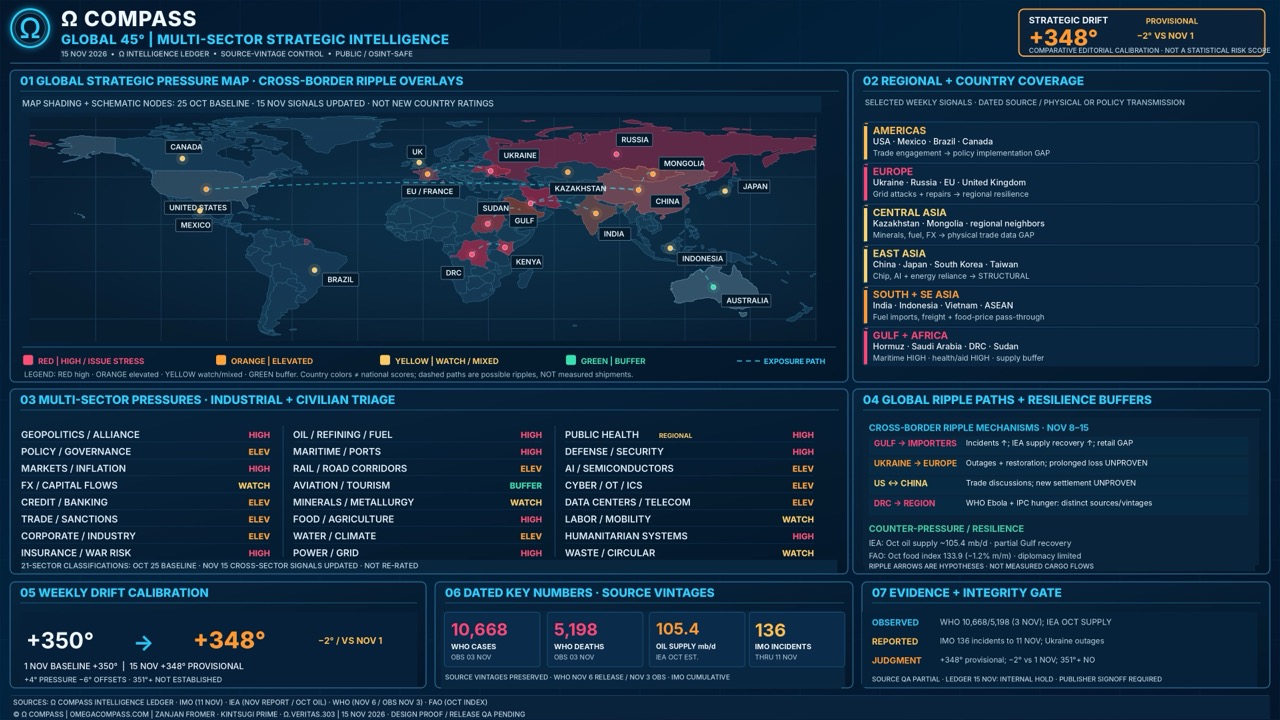
Executive orientation
Analytic judgment — elevated multi-theater coupling persists, with partial operational easing.
The November 8–15 evidence window includes cumulative Gulf maritime-security pressure, reported Russian attacks on Ukrainian energy infrastructure, and severe but geographically concentrated Central African health and humanitarian conditions.
November reporting describes strikes affecting Ukrainian electrical substations, regional outages and ongoing restoration. The reported effects are not equivalent to permanent nationwide capacity loss.
Diplomatic channels also remained active. Russian, Ukrainian and US representatives began talks in Abu Dhabi on November 10, despite continuing hostilities. European diplomatic coordination must be distinguished from participation in those trilateral negotiations.
Separately, the United States and China held trade-council discussions on November 13, reported on November 14, without announcing a comprehensive settlement.
Conversely, IEA-reported oil supply recovery, easing international food commodity prices, limited diplomatic engagement and documented restoration work show that meaningful operational buffers remain.
The defensible assessment is high systemic pressure, not globally synchronized breakdown.
Maritime incidents are not equivalent to cargo losses. Supply recovery is not proof of safe shipping. Diplomatic engagement is not implementation. Global commodity-price easing is not proof of affordable food in conflict zones.
The disclosed editorial bridge assigns +4° to pressure signals and −6° to stabilizing offsets. These are judgment units, not measured probabilities or fitted causal coefficients.
The 351°+ System Breakpoint Envelope remains NOT ESTABLISHED.
Weekly drift continuity & decision gate
Historical calibration continuity · Scroll horizontally on mobile.
| Reference | Recorded reading | Interpretation |
|---|---|---|
| February 25, 2026 | +298° | Inherited public orientation; physical and financial stabilization test. |
| October 4 | +332° original / +336° later comparator | Historical provenance discrepancy preserved. |
| October 11 | +343° | Archived comparative editorial calibration. |
| October 18 | +348° provisional | Earlier editorial judgment, not an independently fitted model. |
| October 25 | +350° provisional | Upper Multi-Theater Coupling Phase. |
| November 1 | +350° provisional | Current comparison baseline. |
| November 15 | +348° PROVISIONAL | −2° comparative movement, reflecting mixed escalation and stabilizing buffers. |
Decision rule: Assess physical and operational reality (Layer 1) together with financial and economic plumbing (Layer 3). Diplomatic statements (Layer 2) do not automatically neutralize continuing damage, delivery constraints or financial stress.
Promotion into the 351°+ System Breakpoint Envelope would require stronger independently documented synchronization of corridor interruptions, infrastructure failures, financial dysfunction and insufficient recovery capacity.
321°–350° is the Multi-Theater Coupling Phase. 351°–400° is the separate System Breakpoint Envelope.
These are editorial analytical categories, not physical rotation, war probabilities or a statistically calibrated index.
November 15 provisional degree bridge — +350° to +348°
Decision: Reduce the provisional Global 45° strategic drift reading by 2° relative to November 1.
| Pressure / counter-signal | Editorial adjustment | Evidence boundary |
|---|---|---|
| Gulf maritime security | +2° | IMO cumulative incidents indicate persistent danger, not universal closure or measured cargo losses. |
| Ukraine infrastructure attacks | +1° | November attacks and subsequent regional outages are documented. Nationwide permanent capacity loss is not established. |
| Central African health and humanitarian pressure | +1° | Surveillance and food insecurity indicate regional stress, not coordinated causation. |
| Oil supply recovery | −4° | IEA November reporting describes October supply recovery and partial recovery of Gulf exports. |
| International food-price easing | −1° | FAO October index declined; local affordability remains distinct. |
| Limited US–China trade engagement | −1° | Trade discussions and previously announced truce arrangements are bounded counter-signals. No comprehensive settlement was established by the meeting. |
Contribution values are editorial judgment units, not measured causal effects or statistical probabilities.
Confidence is MODERATE in the qualitative assessment of partial operational buffers and LOW in the exact precision of the 2° adjustment.
The adjustments are an explainable editorial bridge, not evidence that an independently reproducible event-to-degree statistical model has been validated.
Why not 351°+? Available evidence does not demonstrate sustained, contemporaneous global breakdown across trade corridors, infrastructure, credit/payment functions and recovery capacity.
Public multilayer drift: explainable without revealing proprietary mechanics
| Public layer | What is assessed | Falsifier / de-escalation clue |
|---|---|---|
| Physical and operational reality | Conflict, ports, cargo, grid, health facilities and restoration. | Recovered capacity, lower incident rates and sustained service. |
| Diplomatic / narrative theater | Talks, treaties, rhetoric, legislation and government signals. | Implementation and compliance. |
| Financial / economic plumbing | Insurance, FX, rates, inventories, credit, payments and households. | Lower delivered costs and functioning credit. |
| Alliance and institutional geometry | Coalition behavior, hedging, bilateral and multilateral decisions. | Transactions contradicting assumed alignment. |
| Information and attribution | Source provenance, independent verification and uncertainty. | Original records and identified source dependencies. |
| Industrial and technology substrate | Compute, semiconductors, power, water, minerals and capital. | Commissioned and sustainably supplied capacity. |
The framework uses a multilayer, nonlinear strategic perspective. National policy, financial markets and industrial systems operate on different timelines and can send conflicting signals.
A diplomatic improvement can coexist with infrastructure damage. A market price can rise while physical supply recovers. An investment announcement can precede commercial production by years.
Public analysis discloses observations, source vintage, causal hypotheses, counterevidence and revision conditions.
Proprietary internal routing, unpublished event weights and sensitive cyber/CI procedures are not disclosed.
Regional and transnational operating picture
| Theater / system | Observed status | Ripple pathway / critical gap |
|---|---|---|
| Gulf / Hormuz / Arabian Peninsula | HIGH: IMO cumulative registry: 136 reported confirmed incidents and 25 fatalities through November 11. | Security → shipping and insurance → crude/products → importers. Delivered tonnage requires separate evidence. |
| Ukraine / Russia / Black Sea | HIGH: November infrastructure attacks, regional outages and repairs. Diplomatic talks did not establish a verified cessation of attacks. | Grid → households, transport, industry; Black Sea → freight. Duration and restoration vary. |
| EU / UK / North Atlantic | MIXED: Energy-import exposure, financial transmission and infrastructure resilience. | Fuel, electricity, freight and insurance. No new regionwide outage census. |
| DRC / East-Central Africa | HIGH HEALTH/HUMANITARIAN: Disease surveillance and food insecurity. | Clinics, nutrition, aid and cross-border monitoring. |
| Sudan / Horn / Red Sea | HIGH HUMANITARIAN: Conflict, displacement and aid constraints. | Food access → nutrition → displacement → regional aid demand. |
| United States / China | POLICY STRESS WITH LIMITED OFFSET: Trade discussions and truce measures; no verified comprehensive settlement. | Tariffs, agriculture, technology, licensing and investment. |
| Japan / Korea / Taiwan / ASEAN | STRUCTURAL: Semiconductor, memory, manufacturing and energy dependencies. | Chip output → compute → power and cooling. |
| India / South Asia / Indian Ocean | IMPORT EXPOSURE: Oil, LNG, fertilizers, shipping and FX. | Delivered energy costs → industry and household inflation. |
| Mongolia / China / Russia / Central Asia | MIXED: Mineral-export concentration, fuel imports and FX buffers. | Exports → receipts; fuel imports → logistics and prices. |
| Australia / Pacific | STRUCTURAL OPPORTUNITY: Critical minerals, aviation and energy. | Realized output, passenger/cargo utilization and processing. |
| Americas / commodity exporters | ASYMMETRIC: Different exporter/importer terms-of-trade effects. | Energy, copper, agriculture, capital and household costs. |
Cross-industry, cross-sector and transnational ripple register
Logic: Trigger → physical transmission → commercial/regulatory channel → observed outcome → counter-hypothesis.
A downstream arrow represents a mechanism to test, not proof that every consequence occurred.
| Trigger | Possible transmission | Observed evidence | Next indicator | Disposition |
|---|---|---|---|---|
| Gulf maritime incidents | Security → routing → premiums → delivered costs. | IMO cumulative registry. | Voyages, charter rates and invoices. | HIGH exposure / downstream GAP. |
| Gulf oil supply recovery | Supply → inventories → refining → prices. | IEA November report. | Product imports and retail prices. | BUFFER / local effects unknown. |
| Ukraine infrastructure attacks | Grid → transport, industry and households. | November reporting and energy-authority updates. | Operator restoration and outage hours. | HIGH / effects vary. |
| Ukraine diplomatic track | Talks → proposed terms → possible implementation. | November Abu Dhabi negotiations. | Signed terms, compliance and attack patterns. | ENGAGEMENT / no verified ceasefire. |
| Black Sea maritime risk | Vessel risk → insurance → grain trade. | Regional security reporting. | Port throughput and verified voyages. | CONDITIONAL. |
| DRC disease transmission | Cases → clinical capacity → mobility. | WHO/CDC/ECDC surveillance. | Same-vintage cases, staffing and tracing. | REGIONAL HIGH. |
| DRC food insecurity | Conflict → food access → nutrition. | IPC assessment. | Delivered aid and nutrition. | HUMANITARIAN HIGH. |
| Sudan food systems | Access → markets → nutrition → displacement. | Humanitarian reporting. | Current IPC and aid deliveries. | HIGH / new totals not established. |
| FAO price easing | International prices → import → retail. | October FAO index. | Local baskets and purchasing power. | GLOBAL BUFFER / uneven. |
| US–China trade engagement | Negotiation → rules → shipments. | Trade-council discussions and earlier framework measures. | Final agreements, implementation and customs flows. | LIMITED BUFFER. |
| AI and semiconductors | Capital → chips → grid → compute. | Structural industrial investment. | Commissioned MW and paid utilization. | LONG-ARC. |
| Mongolia minerals and fuel | Exports → FX; imports → CPI. | Structural trade concentration. | Customs, reserves and fuel cover. | MIXED. |
| Critical mineral processing | Ore → refining → components. | Project and policy activity. | Certified output and shipments. | LONG-ARC OPPORTUNITY. |
Multi-sector intelligence coverage & analytical capabilities
Coverage is adaptive rather than a fixed sector count. Materiality, physical networks, source availability and human consequences determine scope.
Missing data are recorded as gaps, not interpreted as no activity.
| Intelligence domain | Measurements / analytical extension |
|---|---|
| Political institutions and governance | Policy, legislation, implementation and capacity. |
| Conflict and civilian protection | Verified incidents, infrastructure and humanitarian access. |
| Energy and petrochemicals | Oil, gas, diesel, refineries, inventories and grids. |
| Maritime security and ports | Incidents, cargo, transit and insurance. |
| Rail, road and aviation | Tonnage, border dwell, passengers and substitution. |
| Trade, tariffs and sanctions | Legal instruments, enforcement and shipments. |
| Finance and sovereign debt | Funding, refinancing, settlement and stress. |
| Currency and capital flows | FX reserves, invoicing and liabilities. |
| Food and agriculture | Harvests, inputs, cold chain and affordability. |
| Water and climate | Drought, storms, hydrology and exposure. |
| Healthcare and epidemiology | Confirmed cases, staffing, supplies and response. |
| Humanitarian systems | Food insecurity, aid, displacement and nutrition. |
| Critical minerals | Extraction, processing and qualified output. |
| Manufacturing and chemicals | Production, energy, fertilizers and inputs. |
| AI and semiconductors | Chips, memory, compute, power and cooling. |
| Cybersecurity and ICS | Digital/OT disruption, recovery and attribution. |
| Corporate power and investment | Ownership, capex and concentration. |
| Employment and wages | Labor markets, skills and household welfare. |
| Waste and circular supply | Recycling, purity and secondary materials. |
| Urban infrastructure | Power, water, housing and transport. |
| Education and research | Institutions, talent and collaboration. |
| Insurance and recovery | Coverage, claims and rebuilding. |
| Space and geospatial systems | Satellite observation and communications. |
| Information verification | Claims, sources, contradictions and uncertainty. |
| Tourism and mobility | Air access, visitors and real spending. |
| Resilience and new capacity | Alternative corridors and domestic value-add. |
Maritime, oil products, insurance and corridor capacity
The International Maritime Organization’s November 11 cumulative Middle East maritime security update reports 136 confirmed incidents and 25 seafarer fatalities through its stated cutoff.
This is a cumulative registry with defined scope, not a count of incidents occurring during November 8–15 alone.
An earlier snapshot recorded 122 incidents and 24 fatalities as of October 30. Differences between cumulative reporting cutoffs should not automatically be treated as newly occurring events.
The IEA’s November Oil Market Report estimated October global oil supply at approximately 105.4 million barrels per day , up approximately 2.3 million barrels per day from September.
The report also describes partial Gulf oil-export recovery while security and refined-product constraints remain relevant.
Supply recovery and maritime deterioration can coexist.
Analytic judgment: Maritime security remains a high-pressure vector, but available evidence does not establish comprehensive Gulf corridor closure.
IMO maritime security and incident records · IEA November 2026 Oil Market Report
Ukraine–Russia: reported attacks, electricity restoration and service resilience
November 8 — infrastructure and maritime claims
Reuters reported Russian claims of strikes against substations in Dnipropetrovsk and Zhytomyr and three cargo ships in or near Black Sea ports.
Reuters said it could not independently verify the Russian military’s claims about the ships and their cargo.
Separately, Ukrainian energy company DTEK reported that damage to energy facilities in Dnipropetrovsk left more than 600,000 people without electricity.
The outage figure is attributed to the operator’s contemporaneous account. It should not be interpreted as a permanent loss of generating capacity.
November 10 — attacks and negotiations
Reuters reported Russian attacks affecting multiple Ukrainian regions, with five major electrical substations targeted according to Ukrainian officials.
Ukraine’s grid operator reported power outages in multiple regions.
The same day, Russian, Ukrainian and US representatives began negotiations in Abu Dhabi.
The simultaneity of negotiations and military operations is documented; it does not, by itself, establish the motives of either party.
November 10 — restoration counter-signal
Ukraine’s First Deputy Energy Minister reportedly stated that power had been restored to all consumers in four regions attacked during the preceding day, while outages and emergency repair work persisted elsewhere.
This demonstrates that attack damage, temporary service loss and permanent capacity loss are not interchangeable.
November 13 — operational update
Reporting attributed to Ukraine’s Energy Ministry indicated that some consumers remained without electricity in 12 listed regions.
Repair crews were reportedly working around the clock; scheduled power cuts and industrial capacity restrictions were also described.
These are attributed, dated operational reports, not a count of permanently disconnected customers.
November 14 — regional disruption
Regional reporting citing energy companies described further attacks and outages, including an attack on a DTEK facility in Odesa region that reportedly left nearly 50,000 households without power.
The figure is regional and time-specific, not a nationwide total. Its exact operational scope should be retained with the original report.
Cross-sector ripple: Power disruption can affect rail, industrial production, household heating, telecommunications, water systems and agricultural processing.
Black Sea maritime risk can influence freight and grain trade. Each downstream impact requires its own measurement.
Counter-test: Restoration, backup generation, rerouting and functioning transmission can limit systemic transmission.
No generalized collapse of European electricity or financial systems is established.
Reuters — November 8 · Reuters syndication — November 10 · Energy Ministry briefing — November 10 · Energy Ministry update — November 13 · Regional update — November 14
Diplomatic tracks: Ukraine negotiations and US–China trade engagement
Russia–Ukraine–US negotiations
Russian, Ukrainian and US representatives began talks in Abu Dhabi on November 10, according to Reuters.
The talks occurred while Russian attacks on Ukrainian energy infrastructure continued.
Statements by participating officials described differing negotiating positions and expectations.
These are attributed diplomatic positions, not proof of agreement.
Separate European coordination
European institutions also reported diplomatic coordination relating to Ukraine and regional security.
European coordination, consultation and support should not be presented as participation in the November 10 Russia–Ukraine–US trilateral talks unless the specific source establishes that participation.
The two diplomatic tracks may be related strategically, but they are not interchangeable events.
A negotiation is an observed diplomatic event.
A ceasefire requires an identifiable agreement and evidence of implementation.
The November talks do not establish that attacks ceased or that a final settlement was reached.
US–China trade discussions
The United States and China had already established a trade framework in September involving reciprocal tariff arrangements and identified product categories.
That earlier framework must be distinguished from subsequent implementation measures and November discussions.
November reporting described continuation of certain truce measures and the first US–China trade-council meeting on November 13.
China’s Commerce Ministry reported the discussions on November 14.
Topics included tariffs, agricultural trade and arrangements associated with the earlier reciprocal tariff framework.
Critical distinction: An existing framework, a subsequent meeting and an implemented tariff reduction are separate evidence states.
The November 13 meeting did not, by itself, establish a newly completed comprehensive trade settlement.
Diplomatic engagement is a limited stabilizing counter-signal.
It may reduce some uncertainty, but cannot be assumed to reverse physical damage, eliminate tariffs, restore restricted technology trade or guarantee compliance.
Reuters — Abu Dhabi talks · European Commission — diplomatic records · Reuters syndication — truce measures · Reuters — November 14 trade council · White House — official policy records
Strategic technology finance, AI production and semiconductor dependencies
Strategic technology competition continues across advanced semiconductors, AI compute, memory, industrial equipment, export controls and cross-border investment.
US–China trade discussions are a limited diplomatic counter-signal. They do not independently establish withdrawal of technology restrictions or restoration of previously constrained supply chains.
Industrial reality test: Announced investment is not commissioned capacity.
Installed capacity is not necessarily qualified production.
Qualified production is not necessarily profitable utilization.
AI electricity and mineral demand are structural cross-sector pressures, not proof of an immediate worldwide compute shortage.
Global health and outbreak forensics: source-vintage control
WHO reporting and CDC documentation are relevant to assessing disease-transmission concerns in the Democratic Republic of the Congo and neighboring health systems.
The previously supplied November 3 and November 6 Bundibugyo Ebola case and death totals have not been independently established against exact dated WHO and CDC documents.
They are therefore withheld from this publication candidate rather than presented as confirmed data.
The outbreak designation, geographic scope, case definition, observation cutoff and original document should all be verified before numerical figures are restored.
Regional transmission and response
Healthcare staffing, isolation capacity, contact tracing, medical supplies and cross-border mobility require continued verification.
Imported cases and traced clusters do not automatically establish uncontrolled global transmission.
This section identifies a regional public-health research priority, not a worldwide pandemic declaration.
WHO Disease Outbreak News · CDC official reporting · ECDC surveillance
Sudan, DRC and transnational food–humanitarian resilience
Sudan continues to face severe conflict-related humanitarian pressure, including displacement, disrupted agriculture, constrained food access and aid-delivery difficulties.
A newly verified Sudan-specific November 15 food-insecurity headcount is not established in this edition.
DRC — separate IPC food-security assessment
The IPC’s DRC assessment estimates 28.8 million people in IPC Phase 3 or worse during September–December 2026, including approximately 3.6 million in Phase 4.
Its January–June 2027 projection rises to approximately 30.3 million in Phase 3 or worse, including approximately 4.2 million in Phase 4.
These are different assessment periods, not newly counted November 15 cases.
The DRC figures must not be attributed to Sudan.
Multiple reports relying on the same IPC assessment are not independent confirmations of separate datasets.
International commodity-price easing cannot be equated with improved food access in conflict-affected areas.
Macro-financial conditions, capital, inflation and households
FAO’s October 2026 Food Price Index stood at approximately 133.9, down 1.2% month on month, but approximately 5.9% above October 2025.
This is an international food-commodity-price counter-signal, not evidence of universal retail price declines.
An energy shock can improve an oil exporter’s receipts while raising fuel, transport and manufacturing costs for importing economies.
Financial truth test: Assess credit availability, sovereign funding, refinancing, payment systems, FX reserves and real household purchasing power.
A change in futures or equity prices does not automatically establish physical production changes, layoffs or defaults.
No globally synchronized financial system failure is established in this assessment.
Mongolia: commodities, external buffers and diversification
Mongolia remains exposed to China-bound mineral exports, imported refined fuels, foreign-exchange pressures and regional transport dependencies.
Bank of Mongolia reserve indicators and IMF assessments provide important analytical anchors.
Historical October values are not relabeled as November 15 observations without a matching official release.
Higher copper or coal receipts may strengthen FX inflows while leaving exposure to commodity volatility and concentrated export destinations.
Third-neighbor technology partnerships, agriculture, tourism, services and advanced processing are possible diversification pathways, not automatically realized production.
Climate, infrastructure, air routes and resilience gains
Extreme-weather exposure should be evaluated through measured outages, transport restrictions, repair duration, insurance claims, rainfall, temperature and hydrological observations.
October 25 Storm Austen and Boelo material belongs to the prior edition and is not represented as a new November 15 event.
Alternative corridors, grid redundancy and new transport capacity can buffer shocks, but design capacity does not equal actual throughput.
Industrial water stress, data-center cooling, hydropower, irrigation and mineral processing can create shared infrastructure dependencies.
Basin-level conflict or supply failure should not be asserted without local measurements and attributable evidence.
Critical minerals, industrial processing and circular resilience
Mineral resilience depends on the entire supply chain, not simply deposit location.
Track exploration, licensing, extraction, ore quality, beneficiation, smelting, separation, qualified materials, components, transport, export controls, buyer diversification and recycling.
Relevant systems include copper, uranium, rare earths, graphite, nickel, lithium, tungsten and specialty chemicals.
Commissioned processing capacity and certified commercial throughput matter more than announcements or diplomatic memoranda alone.
Cyber/ICS, digital sovereignty and supply-chain recovery
Digital compromise can cause physical loss, while physical attacks can disrupt digital services.
These pathways must be distinguished.
Assess confirmed functions affected, operational duration, restoration, substitution capacity and attribution reliability.
A data-center, telecom, payment-system or industrial-controller disruption does not automatically prove a common perpetrator or coordinated operation.
For public release, disclose broad resilience lessons, not exploit instructions, sensitive infrastructure routes or unpublished counterintelligence procedures.
This article describes public analytical categories and resilience considerations.
It does not contain operational penetration instructions, credential material, sensitive infrastructure diagrams or unpublished internal defensive procedures.
Governance, competing narratives and strategic realignment
Diplomatic engagement, proposed policy, implemented restrictions and actual transactions occupy different evidence classes.
The November US–China trade council and Ukraine negotiations illustrate the difference between dialogue and operational outcomes.
Trade discussions did not establish a newly completed comprehensive settlement.
Ukraine negotiations did not establish a verified cessation of attacks.
National policies should be assessed through enacted legal instruments, corporate behavior, financial flows, customs records and production.
Attribution principle: Temporal coincidence across conflicts, markets, outbreaks and infrastructure events is not proof of coordinated intent.
Policy capitals, industrial nodes and transnational secondary effects
A political capital is not an industrial system.
Trace policy from the institution to operating jurisdictions, companies, transport nodes, financial institutions and households.
| Origin | Transmission | Stakeholders | Impact test |
|---|---|---|---|
| Washington / Beijing | Trade council → existing framework or new proposal → legal measures. | Agriculture, semiconductors and minerals. | Signed terms, rules and customs records. |
| Gulf coastal states | Security notices → carriers → insurers. | Asian and European energy users. | Voyages, premiums and invoices. |
| Kyiv / Moscow / Abu Dhabi talks | Military operations and negotiations → grid/service effects and possible diplomatic outcomes. | Households, industry and Black Sea trade. | Restoration, signed terms and compliance. |
| European diplomatic institutions | Consultation and coordination → policy positions and possible support. | Ukraine, European governments and regional security institutions. | Official decisions, commitments and documented implementation. |
| DRC / health authorities | Outbreak response → clinics and borders. | Patients, staff and neighboring systems. | Same-vintage case and tracing data. |
| Mongolia / China trade nodes | Export policy → customs → FX. | Mines, refiners and households. | Customs, fuel stocks and receipts. |
A first-hop verified effect must not be promoted into an unmeasured second- or third-hop consequence.
Near-term risk, opportunity and falsification matrix
| Vector | Escalation indicator | Buffer / contrary evidence | Horizon / disposition |
|---|---|---|---|
| Gulf crude/products | Incidents plus sustained delivery decline. | IEA supply recovery. | Days–weeks / HIGH exposure. |
| Ukraine winter grid | Repeated outages and repair lag. | Documented restoration and backups. | Days–months / HIGH. |
| Ukraine negotiations | Talks fail while attacks intensify. | Verified agreement and compliance. | Days–weeks / CONDITIONAL. |
| Sudan food and aid | Worsening access and nutrition. | Delivered aid and harvest relief. | Weeks–season / HIGH. |
| DRC food insecurity | Worsening IPC phases. | Improved food access and nutrition. | Months / HUMANITARIAN HIGH. |
| DRC disease transmission | Untraced chains and clinical saturation. | Effective surveillance and isolation. | Days–weeks / REGIONAL HIGH. |
| US–China policy | New restrictions and cancelled trade. | Implemented truce measures and functioning flows. | Months / CONDITIONAL. |
| AI industrial buildout | Grid delays and chip constraints. | Qualified yield and paid utilization. | Quarterly / STRUCTURAL. |
| Mongolia fuel/FX | Falling cover and price pass-through. | Reserves and cargo arrivals. | Weeks–quarter / MIXED. |
| System-wide breakdown | Synchronized physical, credit and service failures. | Moving cargo, functioning finance and repairs. | Tail scenario / NOT ESTABLISHED. |
Strategic scenarios and falsifiers
| Scenario | Required developments | Falsifier |
|---|---|---|
| Managed elevated fragmentation | Localized disruption persists while substitutes function. | Extended failures across unrelated systems. |
| Partial operational easing | Reliable cargo, grid repairs, containment and lower costs. | Repeated interruptions and funding stress. |
| Cross-domain synchronization | Simultaneous corridor, infrastructure and credit failures. | Independent buffers and restoration. |
| Adaptive diversification | Qualified processing, alternative routes and compute. | Projects remain uncommissioned. |
Probability policy: No numerical scenario probabilities are asserted.
These are falsifiable analytical pathways, not automated predictions.
Measured reality versus hypothetical ripple — public truth tests
| Initial signal | Establishes | Requires more evidence |
|---|---|---|
| Official statement | Attributed institutional position. | Enactment, compliance and outcomes. |
| Diplomatic meeting | Contact and discussion. | Signed terms and implementation. |
| Maritime registry | Defined incidents to cutoff. | Lost cargo, throughput and invoices. |
| Energy attack report | Reported damage or disruption. | Asset-level impact and lasting capacity loss. |
| Restoration report | Bounded service recovery. | Sustained full capacity. |
| IEA supply figure | Period-specific global estimate. | Local deliveries and retail prices. |
| FAO index | International commodity basket. | Household affordability. |
| Clinical surveillance | Cases within stated scope and reporting vintage. | Current incidence, case definitions and transmission network. |
| IPC assessment | Period-specific phase estimates. | Subsequent outcomes. |
| Project announcement | Intent or commitment. | Commissioning, output and revenue. |
Multiple articles using one government, operator, laboratory or statistical registry are not independent measurements.
Counter-hypotheses, unknowns and Ω.DRIFT checks
Independent shocks: Unrelated actors and events can create similar effects through shared systems.
Adaptation: Rerouting, reserves, repairs and institutional cooperation can offset some pressures.
Reporting artifacts: Different totals may reflect geographic boundaries, definitions and cutoffs.
Coordination claims: Require direct evidence of linkage, not temporal coincidence.
| Expected / question | Observed | Integrity classification |
|---|---|---|
| Explainable November 15 reading | +348°; −2°; +4°/−6° bridge. | EDITORIAL / NUMERIC PRECISION LOW. |
| October 4 consistency | Original +332° / later +336°. | PROVENANCE VARIANCE OPEN. |
| Worldwide media coverage | Selected source families. | NOT EXHAUSTIVE. |
| Maritime incidents equal cargo loss | 136 cumulative through November 11. | NO — THROUGHPUT GAP. |
| Oil recovery means shipping safe | Supply recovery with continuing risk. | NO — DISTINCT MEASURES. |
| Ukraine attacks mean permanent grid collapse | Damage, outages and restoration. | NOT ESTABLISHED. |
| Ukraine talks mean ceasefire | November negotiations. | NO VERIFIED CEASEFIRE. |
| European coordination equals trilateral participation | Separate diplomatic activities. | NOT INTERCHANGEABLE. |
| US–China meeting means new final settlement | November trade council and earlier framework. | NO NEW COMPREHENSIVE AGREEMENT VERIFIED. |
| Global food easing means local affordability | FAO lower; DRC food insecurity severe. | NO — LOCAL ACCESS GAP. |
| DRC IPC figures describe Sudan | 28.8 million belongs to DRC. | GEOGRAPHY CORRECTED. |
| WHO and CDC outbreak figures are identical | Reported figures require exact dated primary-source reconciliation. | NOT VERIFIED — FIGURES WITHHELD. |
| Regional outbreak means global spread | Regional surveillance requires confirmation. | NOT ESTABLISHED. |
| Numeric algorithm independently reproducible | Editorial history; unpublished coefficients. | NOT REPRODUCIBLE FROM PUBLIC RECORD. |
| Final website release certified | Revised HTML editorial candidate. | FINAL QA AND APPROVAL PENDING. |
Research priorities and publication controls
Immediate: Reconcile IMO incidents with vessel movements; confirm Ukraine restoration and duration; compare WHO, CDC and ECDC same-vintage outbreak updates; compare IEA production with delivered products and national fuel prices.
Near term: Review Sudan/DRC aid delivery; track implementation of US–China trade measures; monitor documented outcomes of Ukraine negotiations; reconcile Mongolian fuel cover and FX indicators; inspect shipping premiums and credit.
Long arc: Track mineral refining, AI-grid capacity, industrial substitution, resilient logistics, water dependencies and qualified production.
Verify issuer date and observation date separately.
Distinguish original-source evidence from secondary reporting.
Separate verified fact, observation, hypothesis, analytical judgment and forecast.
Test counter-signals and source independence.
Use exact dated source documents where available; do not substitute a generic institutional homepage for a specific data release.
Remove sensitive information, confirm visual rights, test the WordPress rendering and obtain publisher approval.
No live sensor, automatic publication or private-ledger write is implied.
Public reference register
The register distinguishes original institutional data from dated reporting. A source supports only the proposition identified in its row.
Maritime, oil, diplomatic, health and food-security claims require exact source-specific verification.
Some links below remain institutional directories or secondary reporting rather than direct primary releases.
Granular Ukrainian outage figures, source-specific definitions and remaining historical comparisons retain their stated attribution and final-QA requirements.
| Source | Vintage | Proposition supported | Reference |
|---|---|---|---|
| International Maritime Organization | November 11 cumulative update. | Middle East maritime incidents and fatalities. | IMO records |
| International Energy Agency | November 2026 report. | October oil supply and Gulf recovery. | IEA report |
| Reuters — Ukraine | November 8. | Russian claims and DTEK-reported outages. | Reuters |
| Reuters — Ukraine and talks | November 10. | Grid attacks and Abu Dhabi negotiations. | Reuters syndication |
| Ukraine Energy Ministry | November 10. | Restoration and continuing outages. | Ministry briefing report |
| Ukraine Energy Ministry | November 13. | Outages, repairs and restrictions. | Ministry update |
| UNN / energy-company reports | November 14. | Regional attacks and outages. | Regional reporting |
| European Commission | November 2026 diplomatic context. | Separate European diplomatic coordination concerning Ukraine. | Official institutional records |
| Reuters — US–China trade | November 9. | Continuation of truce measures. | Reuters syndication |
| Reuters — US–China trade council | November 14. | November 13 discussions; no newly announced comprehensive agreement. | Reuters |
| White House | September framework; subsequent policy implementation. | Existing trade arrangements and official policy instruments. | Official records |
| FAO Food Price Index | October 2026. | 133.9 index and monthly change. | FAO |
| World Health Organization | November 2026; exact vintage pending. | DRC outbreak claims require original dated document verification. | WHO outbreak reporting |
| US Centers for Disease Control and Prevention | November 2026; exact vintage pending. | Outbreak totals and definitions not independently confirmed. | CDC official reporting |
| European Centre for Disease Prevention and Control | November 13. | Regional disease surveillance. | ECDC |
| Integrated Food Security Phase Classification | September–December 2026; January–June 2027 projection. | DRC food insecurity. | IPC |
| Bank of Mongolia | Monthly; vintage-specific. | Reserves and monetary indicators. | Bank of Mongolia |
| IMF World Economic Outlook | October 2026. | Macroeconomic projections and risks. | IMF |
| Ω Compass public baseline | February 25, 2026. | Public multilayer drift orientation. | Historical baseline |
| Ω Compass SITREP archive | Historical. | Degree categories and continuity. | SITREP archive |
Institutional landing pages are retained where exact issue-specific links have not been established. They should not be mistaken for citations to a particular archived release. Repeated articles sharing one upstream source are not independent measurements.