November 23, 2026 — Global 45° Strategic SITREP: Multi-Sector Intelligence, Global Ripple Effects & Strategic Drift
Dated public-source assessment of energy, shipping, geopolitical conflict, food and health, minerals and AI, trade and finance—and the measurable domino effects, substitutes and unresolved links connecting them.
November 23, 2026 — Global 45° Strategic Drift Map
The following publisher-supplied visual accompanies this dated multi-sector assessment. The +349° reading remains provisional until editorial sign-off.
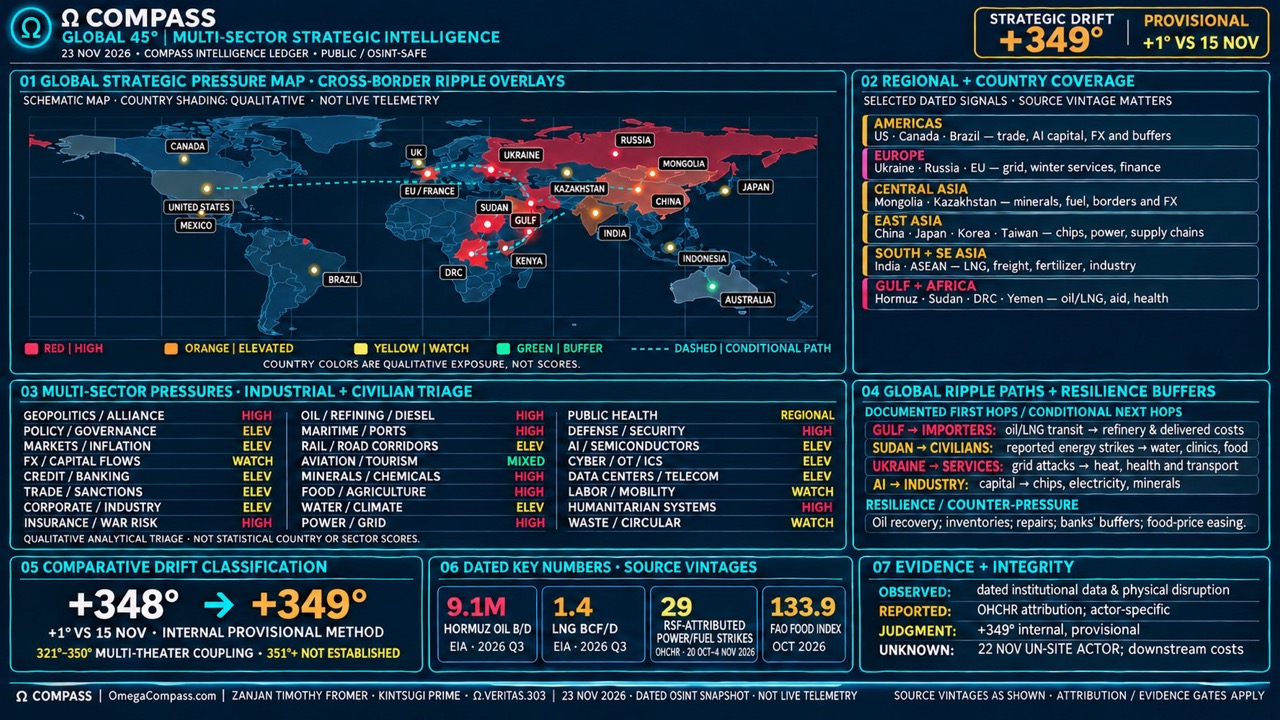
Master synthesis — what the ledgers reveal together
Core judgment: Global systems remain in an upper multi-theater coupling state, but the evidence describes uneven regional disruptions and cross-industry transmission, not a verified synchronized global breakdown. Gulf crude transit recovered from its Q2 low while LNG and refined-fuel constraints persisted. Sudan presents a documented energy-to-water-to-healthcare disruption, not merely a theoretical cascade. Conflict, food access, climate governance, trade measures, AI infrastructure and financial funding conditions interact but do not share a demonstrated directing actor.
| Chain / lead finding | Verified physical or institutional evidence | Cross-sector transmission | Unverified next hop / guardrail |
|---|---|---|---|
| RIP-01 Gulf oil and products | EIA Hormuz oil 21.6 mb/d (2025 Q4) → 5.1 (2026 Q2) → 9.1 (Q3); IEA Oct Gulf exports excl. Oman 18.4 mb/d. | Chokepoint → tankers/insurers → refinery feedstock/diesel → logistics/industry. | Country food-CPI impacts and actual delivered invoices unjoined; EIA and IEA denominators differ. |
| RIP-02 Gulf LNG / industrial inputs | EIA Hormuz LNG 10.5 Bcf/d (2025 Q4) → 0.8 (2026 Q2) → 1.4 (Q3). | Gas/LNG → electricity, petrochemicals, fertilizer and industrial heat. | Terminal-level delivered LNG, price pass-through and substitute availability not matched. |
| RIP-03 Sudan energy-health-food | OHCHR: 29 drone strikes Oct 20–Nov 4, attributed in its report to RSF, struck power/fuel sites across 11 states; outages affected dialysis, surgery, water and food production. | Power/fuel → water pumping/clinics/food systems → civilians and humanitarian access. | No inference that Nov 22 UN premises strike had same perpetrator; UN statement leaves actor unidentified. |
| RIP-04 Ukraine infrastructure/social | UNICEF/HRMMU: 114 children killed and 1,030 injured Jan–Oct 2026; continued energy attacks and repairs. | Power → heat, transport, water and health; conflict → displacement. | Specific facility downtime, repair lag and cross-border market causation need measurement. |
| RIP-05 AI, minerals and finance | Fed: >$2T announced specific data-center plans, fraction realized. IEA documents sulfuric-acid export restriction effects across mineral and fertilizer chains. | Capital → chips/minerals → power/cooling → construction and funding → product costs. | Announcements not commissioned MW; common bottleneck does not prove malicious proxy control. |
Three-ledger fusion: Ledger A grounds the date, affected node and measured quantities; Ledger B flags market estimand errors, time-vintage and price-to-household causality gaps; Ledger C contributes de-identified tactic/void questions but supplies no public actor attribution by analogy. No ledger-only assertion is treated as independently corroborated.
Priority: Verify delivered fuel/LNG at destinations, Sudan asset-level restoration and health service interruptions, Ukraine regional power hours, actual AI-grid commissioning and institutionally adopted COP31 outcome documents.
Executive orientation
Analytic judgment — sustained pressure with selective adaptation. EIA’s November 16 chokepoint observations show incomplete but material Q3 recovery from the Q2 Hormuz trough. IEA’s November 13 report shows October oil-supply recovery alongside continued diesel tightness and expensive freight. The contrast is real: crude availability, refining, fuel products, LNG delivery, shipping safety and household prices are different variables.
The November 17 UN human-rights report adds a separately documented multi-state Sudan domino chain: attacks on electricity and fuel nodes led to blackouts and interrupted essential services. The November 22 UN report of damage to UN premises in Khartoum is a separate event with attribution UNKNOWN. UNICEF’s November 20 Ukraine report emphasizes escalating civilian exposure, not automatic EU-wide service failure.
UNFCCC’s November 22 COP31 closing remarks report failure to agree on both presidency-led decisions even while some other outcomes progressed; trade and finance show both friction and buffers. WTO’s report of H1 trade restrictions and facilitation, ECB’s resilient euro-area banking baseline and FAO’s October international food-price easing provide competing signals.
Weekly drift continuity & decision gate
| Reference | Recorded public orientation | QA note |
|---|---|---|
| Feb 25, 2026 | +298° | Inherited baseline; not recomputed here. |
| Oct 4 | +332° original / +336° later comparator | Unresolved archival provenance discrepancy preserved. |
| Oct 11 | +343° | Historical editorial value. |
| Oct 18 | +348° provisional | Historical editorial value. |
| Oct 25 / Nov 1 | +350° / +350° provisional | Upper coupling phase. |
| Nov 15 | +348° provisional | Prior comparison baseline; −2° vs Nov 1. |
| Nov 23 | +349° PROVISIONAL (proposed) | +1° vs Nov 15; internal framework classification; public empirical assertions remain auditable. |
Decision gate: Promotion to 351°+ would require documented contemporaneous failures across essential international corridors, physical service continuity, financial clearing/credit and capacity to recover. Regionally extreme harm must not be dismissed; it also must not be equated with a verified global system-wide failure.
November 23 comparative evidence context — +348° to +349°
The following public evidence ledger explains which substantive pressures and resilience signals informed the edition comparison. It does not disclose or purport to reconstruct Ω Compass’s proprietary internal calculation.
| Evidence factor | Analytical direction | Attribution and limits |
|---|---|---|
| Sudan multi-sector service disruption and separate Nov 22 strike report | Pressure | OHCHR Nov 17 attributes 29 prior strikes to RSF; Nov 22 UN premises incident perpetrator UNKNOWN. These are separate attribution records. |
| Ukraine civilian casualties and energy-system vulnerability | Pressure | UNICEF Nov 20 / HRMMU January–October counts and energy infrastructure reporting; no claim of new single-day casualties. |
| Trade, AI, mineral and funding dependencies; COP31 decision gap | Conditional pressure | WTO Nov 17, ECB Nov 18, Fed Nov 20, UNFCCC Nov 22. Exposure and governance signals are not demonstrated worldwide cascading failures. |
| Gulf oil-supply recovery and physical substitution | Partial buffer | IEA October output/inventory and EIA Q3 transit are distinct measures and periods; recovery is incomplete and does not establish shipping safety. |
| International food-price easing and euro-area bank capital/liquidity | Partial buffer | FAO October price index and ECB November review; neither establishes universal household affordability or zero credit risk. |
Public evidence methodology and proprietary classification boundary
| Analytical layer | Observed inputs | Independent truth test |
|---|---|---|
| Physical/operational | Vessel movements, cargo, power, water, hospitals, repairs. | Delivered throughput, outages, restoration. |
| Institutional/policy | Diplomacy, regulation, COP negotiations, tariffs. | Adopted instruments and implementation. |
| Financial/economic | IEA stocks, ECB/Fed stability, COFER, commodity prices. | Compatible period, denomination, financing and invoice data. |
| Industry/technology | Acid, refining, fertilizers, AI facilities, water and grid. | Commissioning, qualified output, supplier delivery. |
| Security/attribution | Incident records, attributed allegations, known actor ties. | Authenticated technical, transaction, ownership or official findings. |
| Social/humanitarian | Verified casualties, displacement estimates, clinical capacity. | Source vintage, actual access, aid and outcome measures. |
Run macro → meso → micro and micro → meso → macro in each theater. Every directional edge must be classified VERIFIED MEASURED, DOCUMENTED ASSOCIATION, MECHANISTIC INFERENCE, TESTABLE HYPOTHESIS or UNKNOWN. No behavioral pattern or strategic benefit establishes identity, coordination or intent.
Regional and transnational operating picture
| Region / system | Verified signal to cutoff | Pressure / stabilizer / evidence gap |
|---|---|---|
| Gulf / Hormuz | EIA Q3 Hormuz oil 9.1 mb/d vs 21.6 2025Q4; LNG 1.4 Bcf/d vs 10.5. | High exposure; partial oil rebound; country delivered fuel and LNG gap. |
| Sudan / Red Sea / Horn | OHCHR: >2,230 verified civilian deaths Jan–Oct, >1,630 drone-related; 29 power/fuel strikes Oct 20–Nov 4. | Documented local domino; Nov 22 UN-site attribution UNKNOWN. |
| Ukraine / Russia / Europe | UNICEF: 1,144 verified child casualties Jan–Oct; repeated energy infrastructure attacks. | High war and winter services exposure; operator restoration varies. |
| EU / finance | ECB Nov 18 flags AI/fiscal/geoeconomic risks; euro banks broadly resilient. | Transmission via nonbanks and funding possible, not blanket failure. |
| United States / China / trade | WTO H1 2026 measures 466 facilitating, 333 non-facilitating globally. | Opposing policy effects; no proof common proxy command. |
| India / South Asia | Structural dependence on Gulf fuel, LNG and trade corridors. | Check actual cargo delivery, FX and substitution; no country effect inferred solely from regional estimate. |
| Mongolia / China / Central Asia | Mineral export / fuel-import concentration; alternative corridor exposure. | Need matched November customs, fuel cover and reserve release. |
| Japan / Korea / Taiwan / ASEAN | Interdependent semiconductors, power and intermediate supplies. | AI scale exposure structural; no measured general shutdown. |
| DRC / East-Central Africa | Humanitarian/health constraints; 2026 IPC vintage remains a period estimate. | Country-specific clinical and food-access updates necessary. |
| Yemen / humanitarian | UNFPA Nov 22 estimates >6,400 displaced pregnant women; ≥1,500 potentially needing emergency care. | Estimate, not count of observed admissions. |
| Türkiye / global climate governance | UNFCCC Nov 22: no consensus on both COP31 presidency-led decisions. | Other negotiation outcomes exist; implementation requires separate evidence. |
| Americas / Australia / Pacific | Exporter/importer and critical mineral processing opportunities differ. | Qualified output, financing and route data before any acute ranking. |
Cross-industry, cross-sector and transnational ripple register
| Finding | Observed first hop | Domino / cross-border mechanism | Competing explanation / next proof |
|---|---|---|---|
| Gulf crude | Vessel-transit and October export figures. | Fuel refining → freight/diesel → industry/agriculture/food. | FX, taxes, reserves and supplier substitution; paired landed cargo/retail panels. |
| Hormuz LNG | Quarterly EIA LNG transit remains depressed. | Industrial heat/gas → fertilizer/chemicals → input costs. | Alternative LNG contracts, storage and actual terminal receipts. |
| Sudan power/fuel | UN-documented blackout, health/water/food production disruption. | Infrastructure → essential services → food/health/humanitarian demand. | Attribution incident-specific; facility-level restoration and aid delivery. |
| Ukraine power | Documented conflict and civilian exposure. | Grid → heat/rail/telecom/water → displaced households. | Specific asset-hour and generation repair logs; backups dampen effects. |
| Trade restriction/facilitation | WTO 466 facilitating / 333 restrictive measures H1. | Tariffs → intermediate input pricing → capacity decisions. | Counts ≠ trade volume; monitor customs effect and exemptions. |
| Sulfuric acid bottleneck | IEA notes 2026 China export restriction following sulfur disruption. | Acid used in mineral leaching and fertilizer → agriculture/EV/defense inputs. | Prices and delivered shipments needed by buyer; no covert motive inferred. |
| AI financing | Fed >$2T announced projects, fraction realized. | Data centers → chips/power/cooling/copper → utilities/credit. | Cancellation, alternative suppliers, energized MW and utilization. |
| Global financial exposure | ECB/Fed identify vulnerabilities. | Valuation/funding → borrowers, nonbanks and investment. | Capital/liquidity buffers; measured credit events not supplied. |
| COP31 setback | UNFCCC official Nov 22 remarks on failed presidency-led consensus. | Governance uncertainty → climate investment commitments. | Other decisions adopted; no observed capex decline from closing remarks alone. |
Multi-sector intelligence coverage & overlapping infrastructure
Coverage spans geopolitics, energy, minerals, food, maritime/rail/road/aviation, customs and trade, finance/FX/USD, manufacturing and chemicals, AI/chips/data centers, grids/water, cyber/ICS, defense, health, labor/migration, ownership/procurement, climate and infrastructure resilience.
| Shared node | Overlapping sectors | Stress transfer | Stabilization test |
|---|---|---|---|
| Refined diesel | Freight, mines, farms, hospitals, emergency grids. | Higher delivered fuel costs can constrain logistics and services. | Actual stock cover, subsidies, price, modal shifts. |
| Electric grids | Water, healthcare, refrigeration, rail, AI compute, factories. | Power loss may jointly interrupt critical services. | Outage hours, redundant feed, generators, load restoration. |
| Sulfuric acid | Fertilizers, copper/nickel/cobalt extraction, rare earths. | Single chemical input bridges food and strategic minerals. | Procured tons, acid prices, inventory and substitution. |
| Ports / customs | Energy, agriculture, medicines, manufacturing and banking. | Border holds may propagate to input costs and cash cycles. | Actual dwell, volumes, rerouting and credit. |
| AI / grid / finance | Semiconductors, cooling, minerals, construction, utilities, lenders. | Capex competition and valuation risk may redirect investment. | Commissioned MW, chip acceptance, cash flow, capitalization. |
Maritime, crude, refined fuel, LNG and insurance
EIA direct chokepoint series: Estimated Hormuz total oil flow fell from 21.6 mb/d in 2025 Q4 to 5.1 in 2026 Q2, recovering to 9.1 in Q3. Estimated Hormuz LNG fell from 10.5 Bcf/d in 2025 Q4 to 0.8 in Q2 and 1.4 in Q3. The linked EIA Global Energy Security Data supplement is explicitly dated November 16 and presents these period-specific values in Table 4. Its containing Short-Term Energy Outlook page can display a different parent-release date; use the supplement date for these observations.
IEA separate estimate: October world supply 105.4 mb/d (+2.3 mb/d versus September), October Gulf oil exports excluding Oman 18.4 mb/d (26% below pre-war), and observed world inventories +52 million barrels in October. IEA also reported diesel at roughly $180/barrel in Europe at its reporting time, 77% above pre-war, with elevated freight. These are different series and denominators; DO NOT combine EIA Q3 Hormuz transit with IEA October Gulf exports as a direct percentage change.
Security incidents do not equal delivered cargo losses. Inventory on water is not the same as available onshore stocks. EIA source · IEA source.
Ukraine–Russia: civilian impact, grid damage and service restoration
UNICEF on November 20, citing UN HRMMU, reported at least 114 children killed and 1,030 injured in Ukraine during January–October 2026; 1,144 total verified child casualties. UNICEF also discusses a large rise in verified energy-infrastructure attacks relative to the previous period, with the baseline and definitions stated in that release. These are year-to-date observations, not a Nov 20 event count.
Power-service loss can disrupt heating, water, telecommunications, health facilities and rail, while restoration, generators and network rerouting may dampen propagation. Distinguish facility strike allegation, independently verified damage, consumer outage, outage duration and permanent generation loss. Diplomacy cannot be substituted for service restoration.
Actor discipline: Ukraine and UN agencies attribute attack patterns in their own reporting; attribution to a particular incident requires that incident’s original record. Do not infer one common controlling entity across unrelated European service interruptions. UNICEF Nov 20.
Diplomacy, WTO trade measures and climate negotiations
Trade: WTO’s November 17 retrospective review found 1,048 trade-related measures in January–June 2026, including 466 facilitation measures and 333 restrictive/non-facilitating measures. The continuing stock of import restrictions was estimated to cover $5.4 trillion of imports as of June 30. Measure counts and covered value are not the same as actual trade lost. WTO.
Ukraine diplomatic tracks: Prior November talks and separate European policy engagement remain historical context. A meeting or declaration is not a signed, executed or enforced ceasefire. Verify new terms and compliance before assigning a stabilizing effect.
COP31: UNFCCC Executive Secretary Simon Stiell stated at the November 22 closing plenary that agreement was not reached on both presidency-led decisions; he also noted some other negotiation results including Just Transition. Do not confuse the lack of those two agreements with no COP31 decisions or with measured changes in emissions. UNFCCC Nov 22.
AI production, semiconductors and technology finance
Federal Reserve Governor Lisa Cook’s November 20 speech reports more than $2 trillion in announced specific data-center construction projects, while cautioning that only a fraction has been realized. This is a cited speech, not an audited aggregate of commissioned facilities. The same discussion connects AI capital to construction, semiconductors, electricity and mineral inputs.
ECB’s November Financial Stability Review flags potential cross-asset impacts from AI valuations, nonbank linkages, sovereign debt and energy. Its assessment also indicates aggregate euro-area bank capital and liquidity buffers remain significant. AI investment acceleration does not prove a bubble collapse or a verified global chip outage. Fed Nov 20 · ECB Nov 18.
Public health, surveillance and essential-service dependencies
WHO’s November 21 Ethiopia campaign announcement targeted more than 11.3 million children for polio vaccination across specified regions; campaign targets are not doses verified as delivered. WHO’s South Sudan November 20 preparedness update reports improved self-assessed Bundibugyo virus disease readiness from 29% in May to 72.5% in October; a self-score is not observed emergency response performance.
Sudan’s UN-confirmed power and fuel outages affected dialysis, surgical procedures and water access. This is a documented cross-sector health consequence; it should not be generalized to an international outbreak or assigned to a cyber operation.
Sudan, Yemen, DRC and food–humanitarian resilience
UN OHCHR November 17 reported more than 2,230 verified civilian deaths in Sudan between January and October 2026, over 1,630 drone-related. Its report attributes 29 strikes on energy/fuel sites across 11 states between October 20 and November 4 to the Rapid Support Forces. It describes blackout-driven disruption of clinics, water and food production. These are OHCHR report attributions, not independently reproduced aircraft forensics.
A separate November 22 statement by UN Resident and Humanitarian Coordinator Denise Brown describes drone damage to UN premises in Khartoum. That statement does not identify the perpetrator. Do not merge its attribution with the earlier 29-strike cluster.
UNFPA November 22 estimates over 6,400 recently displaced pregnant women in Yemen; at least 1,500 may require emergency maternal/newborn care. The numbers are estimates of exposure, not confirmed admissions. DRC IPC food insecurity numbers belong to their prior dated assessment periods and should not be relabeled as new November 23 observations.
Finance, food prices, USD and households
FAO’s October 2026 Food Price Index averaged 133.9, down 1.6 points or 1.2% from revised September. It measures internationally traded food commodity prices, not country-specific retail food affordability. The global easing signal coexists with conflict-related distribution failures.
IMF’s September 30 COFER brief reports the US dollar’s share of allocated official foreign-exchange reserves fell from 57.18% in 2026 Q1 to 56.70% in Q2; total reserves grew from $13.10 trillion to $13.22 trillion. Reserve share is not global trade invoicing share, SWIFT messages, RMB settlement or USD funding stress. Claims of a coordinated assault on the dollar are not supported by these observations alone.
ECB’s Nov 18 review observes vulnerabilities from fiscal risks and AI asset valuations while noting resilient aggregate euro-area banks. Markets, credit, cash flow, energy and food can transmit shocks without a synchronized financial failure having occurred. FAO · IMF COFER · ECB.
Mongolia: mineral exports, imported fuels and external buffers
Mongolia remains structurally exposed to concentrated China-bound mineral exports, imported refined fuels, currency sensitivity and regional freight corridors. Avoid declaring a November 23 reserve figure or diesel shortage without the exact-date Bank of Mongolia/customs release. The Central Asia analysis in Ledger C treats corridor dependency as HIGH while explicitly declining to describe acute region-wide war.
Strengthening domestic processing, alternative buyers, reliable power and trade finance is a potential long-arc stabilizer; project announcements are not output. Bank of Mongolia.
Climate governance, grid/water resilience and industrial competition
COP31 ended November 22 without agreement on both presidency-led negotiating decisions, according to the UNFCCC Executive Secretary. Other decisions and action-agenda outcomes were reported. Treat this as an institutional signal, not immediate quantified emissions, GDP or food-price effects.
Actual climate domino risk runs through measured drought/water, grid outages, farm irrigation, data-center cooling, insurance claims and port/rail interruptions. Test basin and facility capacity separately. UNFCCC Nov 22.
Critical minerals, sulfuric acid and fertilizer–industry overlap
The IEA Global Critical Minerals Outlook 2026 identifies a concrete shared chemical-input channel: disrupted sulfur supply led China to curb sulfuric-acid exports in May 2026, creating effects in both fertilizer and mineral-processing value chains. Sulfuric acid is important for processing copper, nickel and cobalt and for agricultural fertilizer inputs.
Temporal discipline: This is historical structural evidence newly relevant to the November synthesis, not a claim that a new ban started November 23. Source-constrained production and price impacts should be assessed using contracted shipments, physical volumes, plant throughput and prices, with ordinary commercial alternatives tested. IEA Critical Minerals 2026.
Cyber/ICS, CI tactic atlas, proxy and attribution gate
Ledger C’s externally relevant public-safe material was used only to generate hypotheses about opaque ownership, information asymmetry, shared infrastructure, procurement and opportunistic substitution. Personal/private observations were not transferred into this report. Similar techniques at micro and state scales do not establish related perpetrators.
| Attribution question | Present finding | Necessary next test |
|---|---|---|
| Sudan 20 Oct–4 Nov strikes | OHCHR report attributes 29 power/fuel strikes to RSF; downstream blackouts documented. | Per-incident evidentiary chain and restoration data; label issuer allegation correctly. |
| Sudan Nov 22 UN premises incident | UN identifies drone damage, no named perpetrator. | Authenticated forensic and independent reporting; actor UNKNOWN. |
| Other power/market outages | Common infrastructure vulnerability does not prove cyber compromise. | Incident timeline, technical telemetry, vendor/operator reports. |
| Bloc/intermediary networks | BRI/BRICS/SCO overlap may shape incentives; bloc membership is not control. | Verified ownership, payments, tasking, contracts or communications. |
For each suspected tactic, separate EVENT, MECHANISM, ACTOR, CONTROL/PROXY, INTENT and CONSEQUENCE with confidence by claim. OVERT/DOCUMENTED, OPAQUE, ALLEGED COVERT, SUBSTANTIATED COVERT and UNKNOWN remain distinct classifications. ECB and Fed identify cyber/system dependencies as risks, not evidence of a common attacker.
Governance, competing narratives and strategic realignment
The WTO documents more restrictive and facilitating measures. The UNFCCC identifies failed high-level COP31 consensus and other progress. IEA identifies high freight/diesel costs and crude supply recovery. These mixed signals are analytically central, not inconsistencies to erase.
For Russia, China, the US, Gulf governments, regional blocs or private firms: benefit from a disruption is not proof of causation, shared forum membership is not proxy control, and parallel adaptation does not require covert coordination. A named actor requires evidence specific to its action.
Policy capitals, industrial nodes and secondary effects
| Policy / initiator | Potential operating node | Verified status | Outcome test |
|---|---|---|---|
| WTO members’ policies | Customs, supplier payments, industrial inputs. | 466 facilitating / 333 restrictive measures H1 2026. | Law, clearance times, delivered shipments, actual cost. |
| UNFCCC parties | Power, finance, mining, transport and agriculture. | COP31 presidency-led agreement gap. | Final adopted decision texts, budget and infrastructure investment. |
| Gulf governments / carriers | Hormuz pipelines, vessel routes, diesel and LNG terminals. | Period-dated transit/export/inventory datasets. | Arrival, discharge and invoices. |
| Sudan belligerents | Power stations, fuel, water and health services. | OHCHR attributed cluster; separate Nov 22 actor unknown. | Incident-specific evidence, outages and medical access. |
| Central-bank / tech actors | Data centers, power interconnection, investment and banks. | Fed announcements; ECB risk analysis. | Metered MW, spending, lending and credit losses. |
Near-term risk, opportunity and falsification matrix
| Vector | Escalation watch | Buffer / disconfirmation | Evidence grade / arc |
|---|---|---|---|
| Hormuz oil/diesel | Sustained discharge fall plus persistent diesel shortage. | October production/inventory recovery, verified delivered cargo. | Measured upstream; local transmission GAP · days–weeks. |
| LNG / industrial heat | Low destination import and storage drawdown. | Substituted LNG/pipeline fuel and seasonal storage. | EIA Q3 measured transit; destination GAP · weeks–months. |
| Sudan energy/health | Repeated power/fuel strikes plus prolonged clinical outages. | Actual restoration, humanitarian access and backup services. | UN documented · days–months. |
| Ukraine power/winter | Outage duration and repair lag spread. | Restoration, alternate supply, functioning rail and heat. | Event and toll verified, asset-hour GAP · weeks. |
| AI/minerals | Transformer/chip/acid shortages plus leveraged financing loss. | Commissioned alternative capacity, utilization and banks’ buffers. | Mixed measured/potential · quarters–years. |
| Trade / COP31 | Implemented restrictions or delayed investment. | Facilitation and functioning capital-project delivery. | Institutional facts; downstream GAP · months–years. |
| Global breakpoint 351°+ | Concurrent prolonged corridors + infrastructure + credit failures. | Cargo recovery, financial clearing and repairs. | NOT ESTABLISHED · conditional tail. |
Strategic scenarios, four arcs and falsifiers
| Conditional scenario | Short / medium / long arc pathway | Falsifier and stabilizer |
|---|---|---|
| A — Managed fragmentation | Localized shocks; cargo and power partially recover; sectors absorb costs through 2027. | Multi-country service/financing breakdown despite substitutes. |
| B — Compounded cascade | Renewed port/fuel shock + grid or cyber failures + credit tightening; cascading costs into production, food and health. | Independent asset restoration, delivered supply, functioning payments. |
| C — Adaptive stabilization | More normalized freight, grid repairs, acid/mineral diversification and completed AI power projects. | Capacity announced but not commissioned, repeated bottlenecks, weakening finance. |
Short arc: hours–7 days incident/service continuity. Medium: 8 days–12 months inventories, insurance, harvest and financing. Long: 1–3 years supplier/industry relocation. Structural: 3–10 years refining, grids, payment architecture and demographics. Later correlation is not evidence of one uninterrupted campaign. No numerical scenario probabilities are asserted.
Measured reality versus hypothetical ripple — truth tests
| Initial datum | It establishes | It does NOT establish |
|---|---|---|
| EIA Q3 Hormuz volume | Defined-quarter transit estimate. | IEA October Gulf exports or buyer-country discharge. |
| IEA 105.4 mb/d October | Global crude supply estimate. | Every refinery has diesel or all importers see price relief. |
| UN/OHCHR attributed drone strikes | Its documented strike set and reported effects. | Independent forensics for every actor or separate Nov 22 incident. |
| UNICEF Jan–Oct casualties | Period-specific verified child toll. | All deaths on Nov 20 or quantified grid-capacity loss. |
| WTO measure tally | Count of policy acts in H1. | Identically sized traded quantities or actor coordination. |
| FAO October index | Global international commodity price basket. | Local household food affordability or improved aid access. |
| IMF COFER share | Official allocated FX reserve composition. | Trade settlement share, CIPS volume or a USD funding crisis. |
| Fed AI investment plan | Reported announced project dollar amount. | Commissioned MW or accepted GPU deliveries. |
| UNFCCC closing speech | UN official procedural characterization. | Exactly which final legal clauses entered force or actual emissions. |
Counter-hypotheses, intelligence voids and Ω.DRIFT integrity
| Question / expectation | Observed | Disposition / next check |
|---|---|---|
| Global 45° brand and degree framework | “Global 45°” names the Ω Compass report series. Its originating architect confirms an internal proprietary degree methodology; the implementation is not part of this public evidence packet. | STANDING CLARIFICATION: do not recycle generic branding/secret-formula objections. Continue auditing factual data, attribution, cross-sector causal claims, revisions and possible misleading interpretation. +349° remains subject to publisher sign-off. |
| EIA/IEA same petroleum measure? | Q3 Hormuz transit vs Oct Gulf exports excl Oman. | NO; preserve each denominator and vintage. |
| All Sudan drone reports same actor? | OHCHR earlier attributed cluster; Nov 22 UN incident no named actor. | NO; attribution case-specific, Nov 22 UNKNOWN. |
| Oil price → specific food CPI | No joined country fuel, FX, subsidy, harvest and food-CPI panel. | CAUSATION GAP; difference-in-differences/lag test. |
| AI buildout completion? | Plans >$2T, fraction realized. | DELIVERY GAP: energization, OEM acceptance and paid use. |
| Exact Oct 4 drift baseline | +332° original vs later +336°. | HISTORICAL PROVENANCE VARIANCE OPEN. |
| COP31 presidency-led decisions | UNFCCC Nov22 no agreement on both. | Confirm final authenticated adopted decision texts before legal claims. |
| All three ledgers fully examined? | Targeted dated tabs/ranges only; private C excluded. | NO; report precise coverage, no ingestion claim. |
| Continuous collection and publication | On-demand source retrieval and human proposal. | NO; no enabled auto-monitor/publishing asserted. |
Test competing explanations: Independent shocks, weather, normal procurement, inventory buffers, changing measurement definitions, voluntary policy choices, different actors and coincidental timing. Voids never prove concealment. Keep unresolved edges visibly unresolved.
Research priorities, verification and release controls
Immediate (next issue): Join EIA/IEA source vintage to tanker discharge, country-level refined products and LNG receipts; collect power outage-duration and hospital service logs from Sudan and Ukraine; authenticate final COP31 decision texts; reconcile November fuel and food household prices with FX/taxes.
Operational: Watch diesel stocks, freight/insurance invoices, critical chemical imports, customs dwell, actual data-center grid commissioning, nonbank funding and sovereign refinancing; compare reported corporate ownership/proxy claims with registries and transaction records.
Long arc: Evaluate diversified mineral/acid suppliers, distributed water/power redundancy, alternative corridors, bank resilience, local fertilizer and food access. Apply SIGNAL → INDEPENDENT TRIANGULATION → ACTION/WATCH only as an explicitly operational approximation where the canonical Ω Triangle implementation cannot be retrieved.
Public reference register, ledger evidence and claim provenance
Publisher/date/claim restriction: direct institutional releases support the exact proposition shown. Ledger observations are internal cross-indexes, NOT independent second sources. Data observed in an earlier month are never relabeled as Nov 23 measurements.
| ID / Original source | Issue / measurement period | Supported assertion | Direct record |
|---|---|---|---|
| EAR-01 · EIA | Global Energy Security Data supplement dated Nov 16; Table 4; Q4 2025–Q3 2026. Parent outlook header may show a different date. | Hormuz oil and LNG flows by quarter, not IEA’s different October Gulf-export measure. | Global Energy Security Data |
| EAR-02 · IEA | Release Nov 13; October 2026 | Global supply 105.4 mb/d, Gulf exports 18.4 mb/d, inventories +52m bbl. | Oil Market Report |
| EAR-03 · OHCHR/UN Sudan | Nov 17; Jan–Oct casualties and Oct20–Nov4 strikes | Verified deaths and OHCHR-attributed power/fuel strike effects. | Sudan report |
| EAR-04 · UN Sudan | Nov 22; Nov 22 event | UN premises damaged by drones, perpetrator not identified. | UN statement |
| EAR-05 · UNICEF/HRMMU | Nov 20; Jan–Oct child casualty period | 114 children killed, 1,030 injured, grid exposure. | UNICEF statement |
| EAR-06 · WTO | Nov 17; H1 2026 measures | 466 facilitating, 333 restrictive, stock of covered trade. | WTO review |
| EAR-07 · UNFCCC | Nov 22; COP31 closing | Presidency-led decisions not agreed; other negotiations progressed. | Closing remarks |
| EAR-08 · Federal Reserve | Nov 20 speech | >$2T announced data-center plans; fraction actual. | Governor Cook |
| EAR-09 · ECB | Nov 18; underlying data vary | AI/geoeconomic/fiscal financial stability risks, bank buffers. | Financial Stability Review |
| EAR-10 · IMF COFER | Sep 30; Q1/Q2 2026 | USD reserves 57.18%→56.70%; reserves $13.10T→$13.22T. | IMF data brief |
| EAR-11 · FAO | Nov 6; October 2026 | Food Price Index 133.9, down 1.2% m/m. | FAO release |
| EAR-12 · IEA Minerals | 2026 Outlook; May acid event | Sulfuric acid restrictions affected mineral/fertilizer supply chains. | IEA minerals |
| EAR-13 · UNFPA Yemen | Nov 22 report; displacement observation cutoff unspecified | >6,400 pregnant displaced; ≥1,500 possibly needing emergency care. | UNFPA |
| EAR-14 · WHO Ethiopia | Nov 21 launch | 11.3m children vaccination target, not completed coverage. | WHO release |
| LED-A · Ω Intelligence Ledger | Selected Nov 23 dated Global SITREP and Physical Evidence Anchors ranges | Event/source index, EIA/IEA/IMF observation period controls; not an independent primary source. | Internal provenance; link withheld for public template. |
| LED-B · Ω Market Observatory | Selected Trading | Daily SITREPs Nov23 2026 rows | Non-comparable estimands, USD/data clock, fuel-food and AI-delivery voids. | Internal provenance; link withheld for public template. |
| LED-C · Ω Cyber/CI | Selected public-safe BRI_BRICS_SCO_Reassessment_v2 records as of Nov 20 | Abstract tactic lens and counter-hypotheses only; confidential observations excluded. | Private provenance; no public access link. |
Research and source-retrieval cutoff: 23 November 2026 (UTC+8), with cited public releases through 22 November. Individual assertion verification and publisher QA remain open where noted. Internal ledger references are identified by role without exposing access-restricted URLs or private observation details.