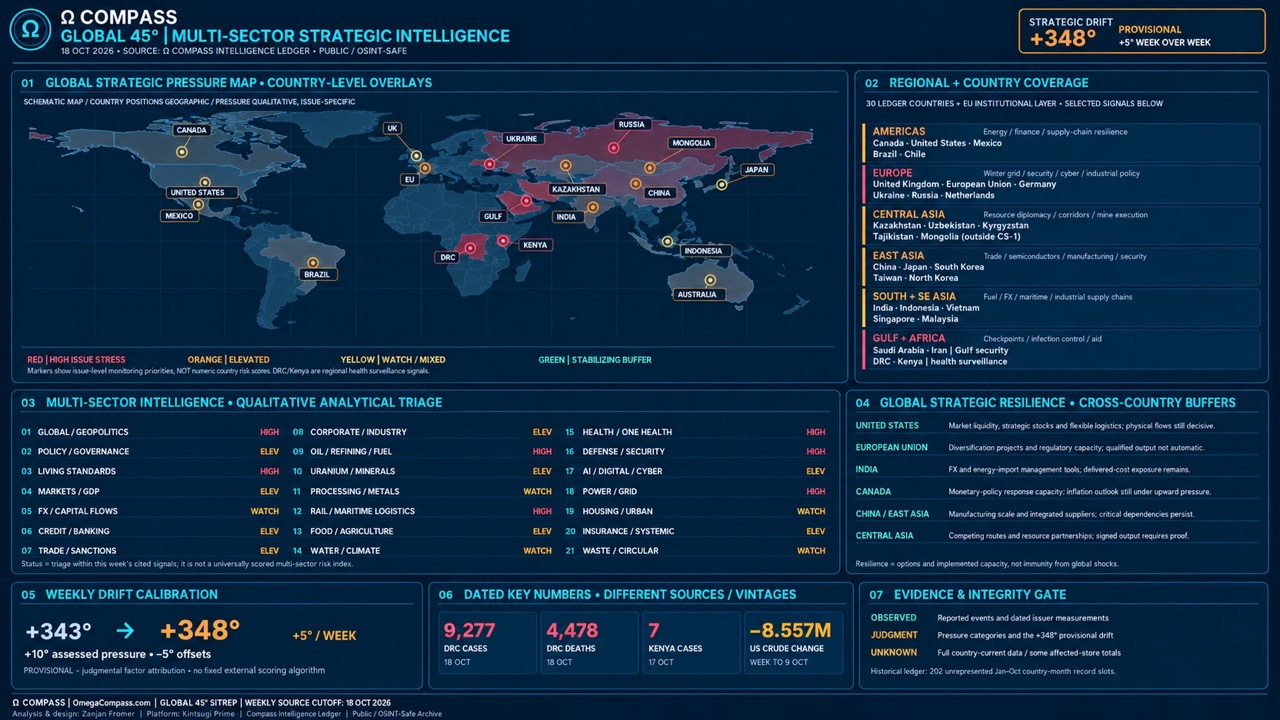
October 18, 2026 — Global 45° SITREP: Expanded Weekly Calibration Across Geopolitics, Security, Energy, Maritime Logistics, Food, Finance, Critical Minerals, AI, Cyber/ICS, Global Health & Mongolia (+348° Provisional)
One week after the October 11 calibration: 30 sovereign-country study lanes plus the European Union institutional layer, 20 cross-sector operating lanes, three regional aggregations, and new source-vintage integrity gates. Comprehensive worldwide implications, but not a claim of complete fresh verification for every country.
 +348°October 18 proposed drift — upper Multi-Theater Coupling Phase
01 — Executive Orientation
Analytic judgment: The global operating environment has widened rather than uniformly deteriorated. Physical conflict exposure and infrastructure stress remain consequential around the Gulf/Red Sea and Ukraine; new Kenya healthcare-associated Bundibugyo Ebola transmission and reported French food-cold-chain cyber losses add independent civilian-system stress. At the same time, tanker freight rates have declined from their recent peak, humanitarian contact tracing has advanced, commercial finance and trade still function, and U.S.–Ukraine intelligence cooperation has reportedly resumed. The October 18 proposed +348° reading is five degrees above the October 11 +343° baseline. This is not a measured 348-degree geophysical rotation, likelihood of global war, or statistical score. It is a transparent, challengeable weekly comparative judgment in the 321°–350° Multi-Theater Coupling Phase defined by Ω Compass. No evidence establishes synchronized global logistics, financial and industrial failure sufficient to promote the system into its 351°+ System Breakpoint Envelope. New material geographies and supply systems include East African outbreak zones and healthcare labor, France/EU cyber-to-food-loss and insurance, Central Asian C5+1 resource diplomacy, China photovoltaic-technology export-control proposals, Korea–Taiwan–U.S. advanced-memory interdependence, Canada inflation expectations, and Mongolia export concentration and fuel-import exposures.02 — Strategic Drift Continuity
↔ Swipe horizontally on mobile to explore all columns.
| Date / calibration | Strategic drift | Documentary status / interpretation |
|---|---|---|
| Jan 1, 2026 | +265° | Continuity baseline inherited from October 11 article |
| Jan 8 | +278° | Operational anchor |
| Jan 22 | +284° | Elevated pressure; inherited |
| Feb 13 | +292° | Prior measured weekly narrative |
| Feb 25 | +298° | Public reporting: corridor advisories, Gaza access, Ukraine repair pace |
| Late Feb | +305° | Ledger continuity marker; no date interpolation |
| Oct 2 | +332° | Multi-domain convergence |
| Oct 4 | +336° | Weekly upper-orange calibration |
| Oct 11 | +343° | Published high-energy, maritime, aviation and weather shocks |
| Oct 18 (proposed) | +348° |
Audited qualitative bridge; not a formal measurement or statistically fitted score |
03 — Calibration Method, Quantitative Bridge & Decision Rule
The February 25 foundational report establishes the decisive hierarchy: Layer 1 physical reality and Layer 3 financial/economic plumbing must stabilize materially before drift is marked down. Layer 2 diplomacy is informative but does not override incidents, corridors, repairs, throughput or risk repricing. The public degree-band chart defines 321°–350° as Multi-Theater Coupling and 351°+ as a System Breakpoint Envelope. Neither page publishes a fixed quantitative algorithm mapping individual events onto degree increments. To make this week’s provisional movement inspectable, the following editorial allocation of comparative contribution units is introduced for this October 18 issue only. It is a declared analytical scoring aid, not a pre-existing Ω Codex equation, an independent measured quantity or a trained actuarial model. A future back-test may replace the discretionary units.↔ Swipe horizontally on mobile to explore all columns.
| Positive pressure / observation | Provisional contribution | Why eligible / limitation |
|---|---|---|
| Kenya: healthcare-associated cases, 3→7 by Oct 17; eight by Oct 18 | +2° | Four cases reported Oct 17 included 3 healthcare workers; an eighth contact-associated case followed Oct 18. Same outbreak counted once; ministry origin common across reports |
| Ukraine: energy-grid strike and outage/repair exposure | +2° | President reports 76 incidents; strike count remains a party statement, no independent 76-event adjudication |
| French refrigeration cyber → physical food spoilage | +2° | Reported operational and material food loss; nationwide store census disputed |
| Gulf maritime insecurity and energy price persistence | +2° | Friday Brent around $109.86; risks and freight still high, no verified corridor-wide normalization |
| Egypt–Saudi conditional military-security posture | +1° | Institutional signaling only; authorization/actual deployment not established |
| Inflation/credit expectations and selective technology financing stress | +1° | Bank of Canada warning and market repricing; not a realized future rate hike |
↔ Swipe horizontally on mobile to explore all columns.
| Stabilizing offset / counter-evidence | Provisional contribution | Why it counters (without overclaiming) |
|---|---|---|
| Gulf of Oman→China tanker freight quote declined WS 841→776 | −2° | A measured/quoted freight-rate easing, though level remains elevated and throughput is uncertain |
| Kenya traced and quarantined 128 of 130 known contacts | −1° | Containment buffer, not proof chain of transmission broken |
| U.S.–Ukraine intelligence sharing reportedly restored | −1° | Ukraine leader statement is a stabilizing operational-support signal; not proof grid repaired |
| Liquidity, trade, alternate capacity and partial market functionality persist | −1° | Avoid treating high volatility as financial/payment system seizure; continuity remains partial |
04 — Global 45° Directional Bearing & Scenario Geometry
Maintain the prior ~64° ±10° inherited directional bearing as continuity. Unlike the rising drift index, there is no new complete actor-alignment and trade-flow model sufficient to assert a different measured orientation today. The bearing concerns the direction of fragmentation; the drift index concerns the accumulated comparative pressure.↔ Swipe horizontally on mobile to explore all columns.
| 30–90-day bearing band | Inherited scenario weight | Interpretation |
|---|---|---|
| 35°–65° | 45% | Managed fragmentation with partial cooperation |
| 65°–90° | 35% | Faster coercive industrial/security separation |
| Above 90° | 8% | Harder institutional divergence and incompatible regimes |
| Below 35° | 12% | Meaningful reconvergence if operational risk and capital constraints ease |
05 — Evidence Taxonomy & Cross-Layer Truth Sensors
↔ Swipe horizontally on mobile to explore all columns.
| Evidence state | Allowed conclusion | Not allowed |
|---|---|---|
| VERIFIED FACT | Original agency/issuer directly supports specific unit/date | Assume downstream causation |
| OBSERVATION | Dated independently observable or attributed reporting | Infer unobserved motive |
| REPORTED CLAIM | Precisely attributed to leader, company, tracker or newsroom | Recast as independently audited fact |
| ANALYTIC JUDGMENT | Reasoned cross-domain linkage with counterevidence | Present as proof of collusion |
| FORECAST | Conditional modeled prospective path | Treat as current output |
| UNKNOWN | Unverified, conflicting, absent original record | Assign zero event rate or cite invented value |
| CONTINUITY | Retain older verified baseline with original date | Present as new October 18 release |
06 — Global Regional/Theater Status Matrix
↔ Swipe horizontally on mobile to explore all columns.
| Region / corridor | October 18 assessment or preserved continuity | Decisive sensor | State |
|---|---|---|---|
| Iran / US / Israel / Hormuz | Conditional Iranian reopening proposal; security incidents and US enforcement remain unresolved | UKMTO/MARAD, ports, AIS, insurers, physical oil cargo |  High / Conditional |
| Saudi / Yemen / Egypt / Red Sea | Sisi support offer, parliamentary discussions continued; not authorization or troop deployment | Egypt legislative proceedings, Saudi request, Yanbu loading, air schedules | Conditional escalation |
| Ukraine / Russia | Zelenskiy reports 76 energy/oil/gas attacks in week; reported US intel sharing resumed | Grid operator MW/repair duration, infrastructure strikes, satellite technical facts | High / Mixed |
| EU27 / France / Germany / Netherlands | EU Council full conclusions; French refrigerator cyber physical damage | Enacted laws, operator loss, insurer claims, national industrial output | Elevated |
| United Kingdom | Non-EU state; financial/cyber trade exposure without fresh national numbers | ONS/BoE original measures, insurance filings |  Review gap |
| DRC / East Africa / Kenya | DRC 9,415 confirmed / 4,536 deaths (data through Oct 16); Kenya 8 cases (Oct 18), including healthcare exposure | ECDC/WHO/MoH dates, health zones, contact trace | Regional health |
| Uganda / Rwanda / South Sudan | Cross-border preparedness; Uganda earlier Ebola episode had ended | MoH origin cases, border screening, any new lab-confirmed case | Surveillance |
| Horn / Ethiopia / Tigray / Eritrea | Inherited conflict and displacement warning; no new measured weekly census | Conflict events, OCHA/UNHCR displacement and border access | Continuity |
| Sudan / Sahel | Humanitarian access, displacement and food-supply degradation persist as historical risk | WFP tonnage and funded distributions, civilian access | Continuity |
| Gaza / Israel / Lebanon | Humanitarian and security operating conditions remain constrained | Aid crossings, reconstruction deliveries, verified damage | Continuity |
| Pakistan / Afghanistan / Balochistan | Cross-border security and mining-route exposure; historical event stream | Border closure logs, industrial site security, Afghan trade | Continuity |
| Central Asia C5+1 | Planned US Samarkand diplomacy with business/mineral agenda | Signed agreements, permits, mined tonnes, energy/grid capacity | Strategic interest |
| China / Taiwan / South Korea | Technology export-control proposals and advanced-memory supplier dependencies | Legal enactment, issuer contracts, wafer/HBM output | Competitive |
| Japan / Southeast Asia / ASEAN | Oil route, semiconductors, food and FX exposure via multiple maritime markets | Official customs, grids, central-bank and port registers | Mixed |
| North Korea / Yellow Sea | Earlier Yalu bridge opening; daily border cargo remains unknown | Port/border manifest and trade legality | Data gap |
| India / Bay of Bengal / Indian Ocean | Oil import FX pressure; US trip and possible trade talks are prospective | RBI original FX, signed deals, vessel invoices | Import exposure |
| US / Canada | EIA Oct 9 crude -8.557m bbl; BoC warns of future inflation revisions | Refining, fuel retail, CPI, decision and US trade | Financial pressure |
| Mexico Pacific / US Gulf | October11 hurricane threats in continuity; current port and production recovery need refresh | NHC final track, Manzanillo throughput, EIA/BSEE | Recovery verification |
| Brazil / Chile / Peru | LAC IMF regional growth forecast not any country actual; copper/soy sensitivity | Official producer volume, export earnings, local CPI | Heterogeneous |
| Australia / New Zealand / Pacific Islands | Australian prior ABS September unemployment 4.7%; regional climate/commodity exposure | Original NSO, Pacific weather/disaster and mineral export tonnage | Measured source gap |
| Mongolia / Russia–China rail trade | 2026 export/reserve buffers but refined fuel/importer dependency, not C5+1 member | NSO/BoM, rail/port transshipment, commodity cash flows | Buffered / exposed |
07 — Ω Multi Sector Intelligence Matrix
↔ Swipe horizontally on mobile to explore all columns.
| Ledger source lane | Recent signal / continuity | Correct measurement requirement | Status |
|---|---|---|---|
| Eurasia Integrated | C5+1 engagement vs Mongolia/China/Russia economic adjacency | Direct agreements and traded units | |
| Political & Governance | Egypt conditional mandate; EU council policy; Iran proposal | Final law, parliamentary result and verified posture | |
| Socioeconomic & Living Standards | Food-price import exposure; Canadian inflation forecast | Real incomes, CPI baskets, wages and displacement | |
| Markets & Macro | Friday Brent $109.86; IMF regional forecasts and rates | Closing-date series, sovereign spread, not forecasts as actuals | |
| FX & Capital Flows | Fuel-dollar demand and inherited India RBI intervention | Official spot, reserve flows, import transaction invoices | |
| Financial Stress & Credit | BoC October 28 projected outlook; selective AI financing risk | Issuer credit spreads, loan default and bank policy decision | |
| Trade & External Earnings | Mongolia official nine-month exports; C5+1 interests | Customs, contracted volumes, trade settlements | |
| Corporate & Industrial Pulse | TSMC Q3 actuals; French retailer financial losses | Issuer releases, production and audited impairment | |
| AI & Technology | HBM reports; chip export permissions; executive AI GDP scenario | Qualified physical chips and signed commercial deals | |
| Regional Fuel & Energy | EIA original draw, high oil and uncertain Gulf ship routes | Product-level bbl, cargo and paid prices | |
| Minerals & Mining | EU strategic project pipeline and Central Asia negotiations | Ore extraction, separation, refinery commissioning | |
| Industrial Processing & Capacity | China proposed PV process controls; steel/refining dependency | Factory output, legal controls, financial close | |
| Supply Chains & Logistics | Gulf VLCC WS 776 from 841; Red Sea and border chains | AIS + port manifest + shipping invoice | |
| Food & Ag Commodities | FAO Sept 136.0; French spoiled cold-chain stock | Farm inputs, tonnage, retail prices, WFP access | |
| Water & Environment | Climate and cooling stress acknowledged; no fresh comparable hydrology | Watershed gauges, drought maps, water consumption | |
| Health | DRC 9,415/4,536 (through Oct 16); Kenya eight by Oct 18; earlier ECDC/Kenya baselines retained | Daily national laboratory count and contact geography | |
| Defense & Security | Ukraine energy strike claims; Egyptian conditional security action | Verified events and actual military/logistics movements | |
| Infrastructure & Digital | French industrial-control incident; Ukraine electrical repair | Outage duration, restored MW, forensic root cause | |
| Waste & Circular Economy | Spoiled perishables, metals recovery and recycling viability | Mass (tonnes), capture efficiency, verified throughput | |
| Risk Sentiment & Insurance | War-risk freight, insurance scope, AI bonds and energy inflation | Bound premiums, actual claims, credit transactions | |
08 — Cross-Domain Divergence, Coupling & Causality Firewall
↔ Swipe horizontally on mobile to explore all columns.
| Trigger | Transmission chain / where evidence stops | Potential outcome | Judgment |
|---|---|---|---|
| Hormuz + Red Sea security | Incident → AIS/routing → rate quote → customs receipts (last two unproven) | Energy, fertilizer and consumer freight cost | Active route exposure |
| Egypt–Saudi offer | Public offer → legislature → Saudi request → assets deployed (not confirmed) | Aviation/energy security | Not implemented |
| Ukraine energy strikes | Claimed incident → physical damaged substations → outages → repair → wages | Cold-weather and industrial supply risk | Physical-system focus |
| French cyber + cold chain | Digital compromise → temperature change → spoiled food → disposal → insurance claim | Food stocks, waste and insurer risk | Reported event / amount void |
| Kenya Ebola healthcare exposure | Imported case → traced contacts → laboratory positives → treatment | Healthcare workforce and local trust | Cases observed / broad community spread not shown |
| C5+1 minerals | Meeting → offtake/finance → processing → measured goods; pending | Industrial diversification and buyer geography | Negotiation not output |
| China PV controls | Consultation → binding rule → license → supply disruption; first stage | Photovoltaic manufacturing/geopolitics | Proposal |
| Samsung/TSMC/Nvidia supply chain | Seoul newspaper report → issuer contract → 3nm die → packaged HBM | AI compute capacity, chip bottlenecks | Reported arrangement |
| FAO + energy inputs | World traded food basket vs farm fuel/fertilizer and household retail | Price and food insecurity | Country pass-through unknown |
| Canada rates vs Gulf oil | Observed oil price → projected inflation → possible BoC action (future) | Credit costs and capital flows | No rate decision |
| Mongolia reserves vs imports | Export receipts → FX reserves / budget; fuel imports → pump prices | National shock absorption | Mixed buffers |
09 — Maritime Security, Aviation, Freight, Insurance & Chokepoints
Hormuz and the Gulf of Oman remain the main near-term Layer 1/3 collision: attack reports, sanctions enforcement and competing reopening proposals coincide with high freight quotes. Iran’s October 18 proposal to reopen Hormuz is an attributed conditional diplomatic offer, not evidence that unrestricted traffic resumed. Egypt’s readiness to help Saudi Arabia is likewise conditional on legal and state-request steps; Reuters reported parliamentary discussion continuing into Monday. The Baltic Exchange Gulf of Oman→China VLCC Worldscale quote moved from 841 to roughly 776 during the week. This direction is a real market counter-indicator but the level remains elevated. Worldscale is a voyage-freight quotation convention, not crude barrels, absolute dollar freight per tonne without fixture terms, a sanctioned vessel count or proof of risk-free transit.↔ Swipe horizontally on mobile to explore all columns.
| Critical chokepoint / node | Layer 1 reality | Layer 3 financial/logistics sensor | Gap |
|---|---|---|---|
| Hormuz / Gulf Oman | Reported vessel attacks and blockade limitations | VLCC Worldscale 776 vs 841; official guidance | Time-aligned throughput and cargo discharge |
| Red Sea / Bab el-Mandeb / Yanbu | Houthi–Saudi tension and alternative route exposure | War-risk quotes, loadings, ports | Actual vessel movements and delivered volumes |
| Riyadh aviation | October11 strike baseline; ongoing security response | Flight schedules, insurance, airport operations | Dated confirmed restoration, not generalized shutdown |
| Suez / Cape of Good Hope | Substitution available, not cost-free | Detour distance, bunker cost and congestion | Verified daily rerouted fleets |
| South China Sea / Taiwan Strait | Close-contact and force-posture continuity | Coast guard encounter frequency, port bills | Independent incident and navigation record |
| North Pacific / Manzanillo | Prior hurricane threat, post-event facts need updated source | Official port closures, rail/road dwell | No assumed multiday closure |
| Mongolia / China–Russia land ports | Landlocked freight/border and gauge dependence | Coal/copper rail, diesel receipts, customs | Actual 2026 weekly tonnage |
10 — Energy, Oil, Gas, Nuclear Safety & Grid Restoration
Friday, October 16 Brent closed around US$109.86/bbl according to October 18 Reuters market reporting. The U.S. EIA directly shows commercial crude stocks (excluding strategic petroleum reserve) declining from 424.134 to 415.577 million barrels between October 2 and October 9, an exactly 8.557-million-barrel weekly decrease. Neither number measures fuel arriving in Mongolia, Europe or India. Ukraine remains an electricity, natural-gas and industrial-infrastructure contest. On October 18 President Zelenskiy attributed 76 attacks on Ukrainian energy/oil/gas assets in the prior week to Russia; that count is a reported official-party statement, not an independently audited database of individual strikes. Separately he reported resumed U.S. intelligence sharing—a partial defensive buffer rather than verified end to damage. IAEA-mediated work to restore Zaporizhzhia nuclear station off-site power is a separate nuclear-safety issue. Track actual external power-line repair, cooling-water reliability, electricity availability and safety status through IAEA and plant operator data; do not use general battlefield reporting as a replacement for technical plant observables.11 — Geopolitical Governance, Alliances & Strategic Hedging
The European Council completed its two-day October 15–16 summit conclusions covering economic competitiveness, Ukraine, the Middle East, defence and the next budget. Official conclusions are institutional policy documents, not automatically national implementation, aid disbursement, enacted legislation or factory production. The UK is not a member of the EU27, and the euro-area growth aggregate does not equal the EU27. The U.S.–Central Asian C5+1 format includes Kazakhstan, Kyrgyzstan, Tajikistan, Turkmenistan and Uzbekistan plus the United States. Reuters on October 18 described Rubio’s scheduled Samarkand diplomacy and more than 200 accompanying business executives, with access to critical resources a commercial focus. Mongolia, Armenia, Georgia and Azerbaijan are not members of that C5 grouping. Middle East alignments are not uniform. Egyptian willingness to defend Saudi interests if requested demonstrates a diplomatic-security posture; it must not be treated as Egyptian entry into war absent a formal parliamentary outcome, Saudi request and observable deployment.12 — Ukraine, Russia & European Energy / Winter Resilience
Treat strike event, damaged equipment, household outage, emergency generator coverage, repair time and lost industrial production as distinct layers. Reports of Ukrainian energy-sector attacks intensify risk, but the count of 76 attributed to President Zelenskiy should be separately corroborated with operator records rather than treated as an independently verified inventory of 76 physical facilities. Counter-indicator: Ukraine’s president reported that U.S. intelligence sharing had resumed; technical restoration of this support may improve warning capabilities. It does not prove a cessation of Russian attacks, successful repair of all transformers or a binding energy ceasefire.↔ Swipe horizontally on mobile to explore all columns.
| Physical truth sensor | Measure to obtain | Failure / buffer distinction |
|---|---|---|
| Power substations and plants | Verified damaged assets, offline MW and restoration time | Damaged does not equal permanently destroyed |
| Nuclear support electricity | IAEA-confirmed independent offsite connection status | Truce announcement not grid restoration |
| Civilian electricity | Average outage hours and affected homes | News headline not outage frequency |
| Defense readiness | Documented warnings, replenishment, protection | Assistance statement not delivered system |
| Logistics and oil infrastructure | Rail/port availability, refinery bbl/d | Strike claim not realized lost output |
13 — Africa, Humanitarian Access & Public Health Geography
The DRC and Kenya outbreak is newly consequential because it involves healthcare-worker infection, contact tracing and strained clinical isolation, not because the disease is shown spreading universally. In Ituri and North Kivu, response access intersects with insecurity and weak healthcare capacity. ECDC’s October 16 situation page describes confirmed affected zones and substantial case burden in eastern DRC. Beyond Ebola, Sudan/Sahel hunger and displacement, the Horn/Ethiopia–Tigray regional tensions, and East African border management remain analytically relevant. These elements are retained continuity unless a date-specific original WFP, OCHA, UNHCR or national source was newly verified. They must not be upgraded to fabricated 18 October troop or displacement totals. Humanitarian access is operational plumbing: permissions, road availability, cold-chain medicines, staffed clinics, nutritional supplies and accessible water; political ceasefire talk without these tangible flows does not constitute durable humanitarian stabilization.14 — Global Finance, Credit, Liquidity & Monetary Transmission
The energy-price environment interacts with sovereign debt, longer-duration funding and emerging-market foreign exchange. Reuters quoted Bank of Canada Governor Tiff Macklem expecting an upward October 28 inflation forecast revision; that is an outlook, not a fresh Canadian CPI release or completed policy rate increase. Reported futures pricing for potential 2027 tightening represents market expectations. Reuters-IMF regional outlooks for the euro area and Latin America/Caribbean are forecasts, not measured 2026 GDP for Germany, the EU27, Brazil or Chile. Similarly, speculative AI-company financing weakness and chip-equity price changes are useful credit-market signals, but do not demonstrate payment-system seizures or universal AI-infrastructure insolvency.↔ Swipe horizontally on mobile to explore all columns.
| Financial lane | Signal | Do not infer | Primary check |
|---|---|---|---|
| Sovereign financing | Debt sustainability / yields concerns | National fiscal default | Official auction yields and IMF country tables |
| Oil and monetary policy | BoC revised inflation projections expected | Oct28 actual rate change | BoC announcement and CPI |
| India / oil FX | RBI fuel-dollar facilities in baseline | Exact current rupee spread | RBI foreign exchange operations |
| Mongolia external buffer | Reported US$8.9bn reserves at September end | Unlimited ability to absorb import-price shocks | BoM actual reserve series and liabilities |
| AI debt and listed securities | Technology equity/credit repricing | Actual physical output collapse | Issuer sales, bond yield and cash flow |
| Marine / cyber insurance | Quoted freight and broker exclusions | Every policy unpaid | Bound premium and claims decision |
15 — Foreign Exchange, Trade, Sanctions & External Earnings
16 — Food Systems, Agriculture, Fertilizers & Humanitarian Nutrition
The FAO September Food Price Index was 136.0, up 1.5% from August and 5.8% year-on-year (released October 2). It measures internationally traded food commodity prices, not a specific Mongolian household’s shopping basket. Grains, fertilizers, diesel, irrigation energy, freight, silos and import regulation all affect delivered food affordability. French refrigeration cyber disruption adds a relatively distinct risk: an industrial-control failure can turn usable perishable inventory into immediate waste. Reuters reports approximately 350 affected outlets; Le Monde reports more than 700, without an independently reconciled denominator. Keep both values attributed and do not publish a national tonnage of wasted food without retailer manifests.↔ Swipe horizontally on mobile to explore all columns.
| Food system | 2026 cited condition | Downstream exposure | Truth sensor |
|---|---|---|---|
| FAO traded commodity basket | September 136.0; +1.5% MoM | Prices imported into national markets | FAO component index, domestic CPI |
| Wheat/rice/feed grains | Global inventories differ by crop and country | Import and feed costs | USDA, FAO, national harvest units |
| Fertilizer and ammonia | Gas and Gulf shipping risk | Harvest input costs after lag | Farm-gate prices, fertilizer import tonnes |
| Food cold chain / retail | France October cyber-linked spoilage | Lost perishable stock; uninsured loss | Store counts, kg discarded, cold room logs |
| Livestock / Mongolia | Winter transport and fodder exposure | Meat and dairy consumer affordability | NSO price and supply measurements |
| Humanitarian nutrition | Sudan/Yemen/Gaza access constraints | Acute malnutrition if aid fails | WFP distributions, IPC and mortality surveillance |
17 — Critical Minerals, Mining, Processing & Offtake
Use a stage-specific value chain rather than a binary rich/poor mineral map. Strategic control and value depend on permits, beneficiation, separation, refining, metallurgical purity, component qualification, power, financing, buyers and recycling—not deposits alone. EU strategic raw-material project designation is a meaningful policy stage, not commissioned production.↔ Swipe horizontally on mobile to explore all columns.
| Material / geography | Industrial function | Bottleneck and strategic truth sensor |
|---|---|---|
| Mongolian copper | Grids, motors, transformers and electronics | Mine-to-processed copper volumes, power, capex, buyer contracts |
| Mongolian coal | Export earnings, metallurgical/fuel trade | Coal grade, buyer concentration, freight and fiscal reliance |
| Central Asian rare earths | Magnets, motors, advanced manufacturing | C5+1 diplomacy vs signed refining/offtake and output |
| Chinese rare-earth separation | Magnet-quality intermediate production | Export licensing, industrial alternatives and capacity utilization |
| Lithium, nickel, cobalt, graphite | Batteries and EV energy storage | Conversion/refining purity, affordability, recycling recovery |
| Tungsten / fluorspar | Special steels, chemicals, defense and manufacturing | Reagents, qualified output, trade channels |
| Uranium / nuclear fuel | Fuel processing and energy security | Safeguards, conversion, enrichment legal capacity |
| Chile / Peru copper | Global industrial metals and grid demand | Ore grades, Chilean/Peruvian producer tonnes and power |
| DRC / southern Africa minerals | Cobalt/copper supply linked to humanitarian and labor systems | Mine safety, legal exports, processing, traceability |
| Waste and by-product minerals | Secondary copper, lithium and high-value recovered metals | Certified recovery yield vs theoretical potential |
18 — AI, Semiconductors, Digital Industry, Power & Cooling
AI industrial capability is a coupled infrastructure chain: accelerators → advanced memory → wafer fabrication/packaging → data-center compute → electricity → grid connections → cooling/water → capital → utilization/revenue. A strong foundry earnings report is an issuer financial result, not the same as new operating installed megawatts. Reuters October 18 relayed a Seoul newspaper report suggesting Samsung and TSMC technology collaboration in advanced Nvidia-oriented memory dies; confirm with the named issuers before classifying it as finalized production. Reuters October 15 described conditional SK Hynix NAND investments and U.S. export-license discussions. China’s October 18 proposed controls on certain solar manufacturing technologies are consultative export-control proposals, not a demonstrated full ban. Corporate executives’ claims of dramatic future GDP increases from AI must be treated as hypotheses. Likewise, high chip and data-center investment budgets may create supplier orders without establishing that grids, transformers, water, financing and ultimate customer demand have aligned.↔ Swipe horizontally on mobile to explore all columns.
| AI/compute dependency | Potential stress | Verification before upgrading |
|---|---|---|
| Semiconductor wafer production | Foundry lead times and cost | TSMC/Samsung actual wafers, utilization |
| HBM / advanced packaging | Supplier concentration and standards | Issuer signed foundry/assembly agreement, shipped units |
| Energy generation | Firm baseload and marginal power price | Operating MW, electricity mix and reliability |
| Grid & transformers | Interconnection queues and bottlenecks | Utility confirmed MW and connection date |
| Cooling, land and water | Thermal discharge and basin constraints | Withdrawal, temperature and recycling metrics |
| Capital and debt | Funding rates/issuer leverage | Closed financing and credit spreads |
| AI monetization | Gap between buildout and cash flow | Utilization, signed customer consumption and audited revenue |
| Export regulation | US/China chip & China solar technology proposals | Legally operative licensing or binding order |
19 — Industrial Processing, Manufacturing & Corporate Capacity
Distinguish announcement → authorization → construction → commissioning → qualification → sustained output. Applied to solar manufacturing, Beijing’s proposed rules concerning manufacturing technologies and advanced cell production would matter most if enacted, implemented and linked to observed technology licensing and production shifts. Applied to EU raw-materials initiatives, designations require power, environmental permits, capital and industrial buyers before supply dependence falls. A business ledger can include both output and constraints: TSMC Q3 2026 issuer earnings; French retail tangible inventory loss; Russia refining throughput gaps; Latin American copper investment proposals; and Mongolia mineral exports versus processing dependence. Do not combine these into a single fabricated global manufacturing productivity rate.20 — Cyber, Industrial Control Systems, Food Loss & Digital Resilience
The French supermarket refrigeration case is a documented cyber-to-physical exposure: unauthorized manipulation of connected temperature systems reportedly led to perishable-food destruction. An attacker’s identity and exact technical intrusion route were not independently established; state attribution from system effects alone is prohibited. The incident raises food safety, equipment supplier, insurance wording, retailer cost and waste recovery issues. Reuters quoted a roughly 350-store scope; Le Monde published a larger figure exceeding 700. These may use different universes, but absent the underlying consistent chain-level census, the correct status is Ω.DRIFT — VARIANCE OPEN. Never convert temperatures reported at some outlets into uniform temperatures at all stores.21 — Climate, Extreme Weather, Water, Hydro-Resilience & Agriculture
Preserve October 11’s hurricane Isaias/Simon continuity, but do not repeat earlier threatened Manzanillo port disruption as a newly verified October 18 shutdown. Physical truth sensors: National Hurricane Center advisories, official port notice, grid/rail restoration, storm damage assessments and oil platform restart. The same discipline applies to Asian floods, Mongolia drought/winter, hydropower reservoirs and Arctic maritime weather. Data-center water and mine processing can compete with household, livestock and agricultural requirements in stressed basins. This linkage is an analytic concern, not a confirmed October 18 basin-level withdrawal number. New gauge readings, water rights and cooling use need local primary data.22 — Waste, Circular Economy & Secondary Mineral Recovery
Cyber-induced food waste is an immediate measurable opportunity for better recovery accounting, but current reports provide monetary-loss estimates and selected retailer accounts rather than a reconciled national tonnage. At the strategic end of the chain, battery, solar, grid transformer and scrap-metal recycling may reduce import dependence only where collection, separation yield, power and commercial purity are independently certified. Use weighted flows, not narratives: collection tonnes × verified recovery yield × marketable-quality fraction × realized selling price, less costs and environmental externalities. No new comparable October 18 global municipal-waste index was verified in the ledger.23 — Global Health and Outbreak Forensics
DRC: ECDC’s October 16 surveillance report recorded 9,277 confirmed Bundibugyo Ebola cases and 4,478 deaths, using data through October 14, with 924 patients in isolation. CDC also reported the same numerical pair for that reference period.
October 18 update: A newer DRC national situation report, covering data through October 16 and reported by Reuters on October 18, recorded 9,415 confirmed cases and 4,536 deaths. Congo’s National Institute for Biomedical Research also confirmed that the outbreak had reached an eighth province, North Ubangi, where two cases, including one death, were identified. These figures represent different reporting vintages, not necessarily conflicting institutional estimates. Original national case-line revisions remain subject to verification.
Kenya: WHO Africa’s October 16 release described the third confirmed case. On October 17, Kenya’s health ministry reported four additional positives, including three healthcare workers and a close relative, bringing the total to seven cases, including one death. At that reporting stage, 128 of 130 identified contacts had been traced and quarantined.
October 18 update: Kenya’s Director-General for Health confirmed an eighth Ebola case, bringing the national total to eight, including one death. The newly confirmed patient was a 49-year-old patient attendant, not a healthcare worker, who reportedly handled utensils and linens and was likely exposed through contact with the original patient. He developed symptoms while under quarantine and subsequently tested positive.
Regional transmission assessment: These developments demonstrate documented cross-border introduction and subsequent contact-associated transmission, including healthcare exposure. They do not independently establish uncontrolled nationwide community transmission or generalized international spread. Continue tracking laboratory-confirmed cases, healthcare-worker infections, contact tracing, geographic expansion, treatment capacity and independently verified national reporting dates.
↔ Swipe horizontally on mobile to explore all columns.
| Geography / organism | Latest dated observation | What is not implied | Next truth sensor |
|---|---|---|---|
| DRC / Bundibugyo Ebola | 9,415 confirmed / 4,536 deaths (DRC data through Oct 16, reported Oct 18); earlier ECDC: 9,277 / 4,478 (data through Oct 14) | No independent DRC case-line verification or case count with an Oct 18 data cut-off established | National original MoH/COUSP and case-zone increments |
| Kenya / Bundibugyo Ebola | 8 cases as of Oct 18; prior 7 on Oct 17; healthcare and patient-attendant exposures | No generalized national epidemic demonstrated | Ministry Oct 18 original, updated contacts and clinical outcomes |
| Uganda / Bundibugyo prior outbreak | ECDC records earlier Uganda episode declared ended Aug25 | Travel transit does not prove renewed local cases | New laboratory confirmation if any |
| Europe / imported cases | Medically evacuated treatment cases in multiple countries | No general local community transmission | National public health authority |
| Mongolia / winter respiratory | Prior domestic vaccination reference, not new pandemic count | No domestic Ebola case identified by these sources | MoH influenza, hospital occupancy and border surveillance |
| Western Pacific / avian flu/dengue | Continuous background surveillance required | No new outbreak counts verified in this pass | WHO Western Pacific and national surveillance |
24 — Mongolia: Reserves, Coal, Copper, Fuel, FX and Economic Optionality
Mongolia’s Ministry of Economy and Development reported on October 7 that September-end reserves reached approximately US$8.9 billion, with US$16.6 billion export earnings over the first nine months of 2026, including US$15.8 billion mining, US$7.1 billion copper concentrate and US$6.1 billion coal. These are issuer-reported dated figures, not independently updated October 18 statistics. The source also reports border-related road and smart/customs improvements; individual delivered cargo quantities still require reconciliation. This is both strength and concentration: reserve accumulation and export earnings provide buffers, while dependence on commodities, refined fuel imports, two main neighboring transit systems and price/volume swings can transmit shocks to public spending and household prices. Mongolia is geographically in Asia but not a U.S. C5+1 participant. Any regional rare-earth deal must be tested for actual Mongolian bilateral benefits rather than assumed.↔ Swipe horizontally on mobile to explore all columns.
| Mongolia strategic lane | Source baseline / opportunity | Exposure / verification requirement |
|---|---|---|
| Reserves / exchange rate | US$8.9bn September reserves (Oct7 ministry) | BoM dated actual liquid reserves, FX liabilities and MNT rate |
| Mining external earnings | US$15.8bn 9-month mining exports | Commodity mix, buyer receipts, inventory and customs |
| Copper concentrate | US$7.1bn nine-month export receipts | Grade, pricing, concentrate volumes, domestic smelter viability |
| Coal exports | US$6.1bn nine-month receipts | China demand, metallurgical grade, future domestic alternative revenue |
| Refined fuel imports | Supplier and rail dependence | Diesel/gasoline paid imports, stock coverage and pump prices |
| Industrial diversification | Copper products, motors, small electronics, EV components | Actual investment, utility MW, quality certification, markets |
| Non-mineral GDP | Tourism, livestock, meat, textiles, IT and logistics | Production, skilled jobs and service export earnings |
| Third-neighbor choices | Korea/Japan/EU/US finance and technology | Executed supply, technology and offtake contracts |
| Border modernization | Tavantolgoi–Gashuunsukhait route and digitized ports reported | Average dwell, border throughput, realized cost savings |
25 — Northern/Central Asia, Cross-Border Land Trade and Regional Hedging
Assess Kazakhstan (energy, uranium, logistics), Uzbekistan (industrial mineral opportunities and Samarkand diplomacy), Kyrgyzstan and Tajikistan (remittances, energy, hydropower), Turkmenistan (gas and transport), Azerbaijan/Georgia/Armenia (Caucasus transit) and Mongolia separately. Regionwide IMF forecasts or meetings do not establish any one country’s GDP, mining output, sanctions policy or household wellbeing. Additional land-trade truth sensors: Trans-Caspian commercial cargo, Caspian port handling, Russian rail and fuel exports, China–Mongolia rail gauge and customs, North Korea’s recently reported Yalu bridge opening and verified truck/tonnage series. A bridge opening does not by itself certify sustained freight volume or legal commodity class.26 — Northeast Asia, Indo-Pacific Security and Technology Dependencies
Taiwan foundry concentration, South Korea advanced memory, Japan industrial inputs, India energy imports and ASEAN manufacturing are interconnected but not one unified alliance or industrial bloc. The October 18 Samsung/TSMC memory story rests on a Seoul newspaper report relayed by Reuters; the signed participant confirmation, manufacturing responsibility and actual 3nm/HBM output require separate verification. Taiwan labor relations and Korean export-control licensing similarly operate on distinct time horizons. In maritime Asia retain South China Sea close-contact caution and Korean Peninsula deterrence continuity. These risks warrant incident-level source checks (national coast guards, naval statements, satellite and vessel records) before claiming a fresh confrontation during October 11–18.27 — Americas, Latin America and Commodity-Exporters
North American energy and credit behavior transmits globally through oil futures, shipping and interest rates, but the EIA crude stock figure alone does not explain national gasoline price changes. Canada’s prospective inflation revision is a policy-risk signal, not a measured rise of 100 basis points in borrowing costs. Latin America and Caribbean IMF growth commentary concerns a regional aggregate; Brazil farm receipts, Chile and Peru copper output, Mexico Pacific ports and household inflation need their own statistical products. Commodity exporters can benefit from higher global selling prices while losing through imports, finance, transport and environmental damage; evaluate net position with independently measured volumes.28 — Risk Matrix: 7–21 Days and 30–90 Days
↔ Swipe horizontally on mobile to explore all columns.
| Risk vector | 7–21-day indicators | 30–90-day risk judgment | Impact / control state |
|---|---|---|---|
| Hormuz/Red Sea joint physical disruption | Verified sustained transits decline + insurance increase | High impact / likelihood uncertain | Severe network node |
| Egypt–Saudi conflict spillover | Formal request and deployment after legislature | Medium probability judgment, not quantified | Contingent |
| Ukraine winter electricity degradation | Grid assets hit faster than repair pace | High potential impact | Persistent exposure |
| Ebola further Kenyan healthcare cases | New transmission chains beyond traced cohort | Medium/uncertain, high local impact | Regional |
| Cyber/ICS spoilage spreads to others | Authenticated incidents with matching root cause | Medium uncertainty, high industry impact | Containable if controls improve |
| Food import inflation | Farm/fertilizer costs reach consumer prices | Medium-high variable by importer | Heterogeneous |
| Sovereign finance deterioration | Funding spreads / failed auctions / credit defaults | Medium, country-specific | Watch |
| China technology control enacted | Official rule and rejected licenses | Medium, strategic | Proposal currently |
| Mineral projects financing delayed | Projects lack closure and refinery commissioning | High structural fragility | Slow burn |
| AI/data center buildout mismatch | Power and capital fail to arrive vs orders | Medium-high sector stress | Structural |
| Mongolia fuel delivery gap | National days-on-hand and paid fuel invoice | Medium exposure, localized consequence | Border dependent |
| Large-scale global cascading system failure | Multiple real corridor, financial, infrastructure failures | Low assessed likelihood, extreme impact | Tail only |
29 — Void, Data Gaps, Mirror Tests & Ω.DRIFT Register
↔ Swipe horizontally on mobile to explore all columns.
| Expected verification | Observed or accessible state | Integrity disposition |
|---|---|---|
| Existing 125-sheet ledger architecture | 30 country studies + 1 EU + 20 sector lanes + regionals and archives inspected | MATCH (metadata), not every historical cell reverified |
| DRC Oct 14 historical tally and Oct 16 updated tally | ECDC/CDC Oct 14: 9,277/4,478; DRC Oct 16: 9,415/4,536 as reported Oct 18 | DATED VINTAGES; later bulletin attributed; original line-list audit pending |
| Kenya Oct 17–18 case-count updates | Seven cases reported Oct 17; eight reported Oct 18, according to national health authorities and Reuters | DATED SEQUENCE; original MoH reports not independently archived here |
| Exact French affected retailer universe | Reuters ~350; Le Monde >700 | Ω.DRIFT — VARIANCE OPEN |
| Egypt security deployment | Statements and talks; no verified authorization/deployment | NO IMPLEMENTATION PROOF |
| C5+1 delivered mineral tonnes | Visit/trade interest, no concluded signed offtake | UNKNOWN / PROPOSAL STAGE |
| VLCC freight/physical cargo equivalence | Worldscale fell 841→776, cargo quantities unspecified | PRICE OBSERVATION / THROUGHPUT UNKNOWN |
| New China solar-control binding law | Reported proposed technology controls | POLICY PROPOSAL ONLY |
| Taiwan HBM foundry agreement | Reuters relays Seoul media | SECONDARY INDUSTRY REPORT |
| Mongolia current weekly import/FX | Oct7 ministry baseline, no full Oct18 new original release | SOURCE VINTAGE GAP |
| Jan–Oct 2026 monthly dated ledger events across 30 countries | 202 absent country-month dated-record slots carried forward | HISTORIC COVERAGE GAP, not zero events |
| Site publication, continuous collection and SHA verification | No automatic website publication or continuous collection was triggered by report preparation; manual publication and on-demand review are separate | MANUAL PUBLICATION / no independent hash certification |
30 — Counter-Hypotheses and Attribution Firewall
- Independent shocks and common dependencies: Many actors may behave separately, while sharing energy, shipping, grid, food, capital and health vulnerabilities.
- Selective coordination: Governments and companies may negotiate or align around particular corridors or materials without any unified command chain.
- Central coordination hypothesis: Requires independent operational communications, financing, instructions or other direct evidence; coincidence, repeated slogans and timing are insufficient.
- Recovery hypothesis: Price easing, restored support systems, contact tracing, infrastructure repair and substitutions may offset new isolated pressures.
- Source-reporting artifact hypothesis: Fast-moving webpages, differently dated totals, syndication and category differences can create apparent contradictions.
31 — Counter-Indicators and Buffers
- VLCC freight price signal eased from Worldscale 841 to 776 on the Gulf of Oman–China route, although still high.
- Kenya identified and placed most recorded Ebola contacts under tracing/quarantine, leaving two still sought in October 17 reporting.
- Ukraine’s president reported U.S. intelligence sharing resumed; this supports capability without repairing grid equipment.
- Global finance, trade and payment systems have not been shown entering generalized simultaneous operational seizure.
- Commercial cargo substitution, strategic stocks, protected infrastructure and working supply chains remain potential partial buffers.
- EU diplomatic and industrial channels remain active, though announced policies are not enacted capacity.
- Mongolia’s September reserves and nine-month export receipts are material dated shock absorbers, with concentration limits.
- Humanitarian surveillance, EU/WHO public reporting, specialist news and primary institution data continue enabling checks.
32 — Four Strategic Scenarios
↔ Swipe horizontally on mobile to explore all columns.
| Scenario | 30–90-day conditions | Drift recalibration trigger | Evidence confidence |
|---|---|---|---|
| A. Entrenched managed volatility | Selective Gulf transit, recurrent grid damage, localized health containment and expensive capital | Mid-to-upper 340s possible; not automatic | MODERATE judgment |
| B. Physical + financial de-risk | Sustained quieter maritime warnings, cargo normalization, real grid repairs and household price relief | Review lower 330s–340s based on measurements | LOW–MODERATE judgment |
| C. Synchronizing cross-system shocks | Multiple corridor closures plus major power failure, credit repricing and prolonged disruption | Review 351°+ only with multiple simultaneous primary sensors | LOW–MODERATE judgment |
| D. Systemic rupture tail | Financial payments/funding disabled, broad prolonged energy and supply interruption, escalating conflict | New qualitatively different analytical state, not routine +3° | LOW likelihood / EXTREME impact |
33 — Strategic Implications Across Public and Private Sectors
- Energy operators: measure cargo, refinery and end-user reliability, not headlines or oil futures alone.
- Shipping and aviation: coordinate port, insurance, airspace and carrier data with incident date and unique voyage.
- Governments: separate announcements, statutes, contracts, cash disbursements and measurable implementation.
- Financial institutions: pressure-test sovereign yields, oil-dollar exposure, AI leverage and cyber-to-physical insurance gaps.
- Healthcare systems: strengthen workforce protection, diagnostic vintages, contact follow-up and geographically bounded communications.
- Farm and food chains: capture fertilizer and diesel invoice costs plus temperature and food loss by retail outlet.
- Critical minerals manufacturers: contract qualified materials and processing capacity rather than relying on deposit listings.
- AI and semiconductors: match chips, memory, grid MW, cooling water, capital budgets and validated commercial revenue.
- Landlocked economies: improve customs, stock buffers, rail dwell and diversification by verified trade partner.
- Humanitarian response: use actual aid distribution, permissions, health capacity and safe access as primary stability sensors.
- Public intelligence: preserve source-as-of timestamps, report revised numerators and test counter-hypotheses.
34 — Collection Priorities: Next 72 Hours, 7–21 Days, Quarterly
↔ Swipe horizontally on mobile to explore all columns.
| Time horizon | Primary collections | Decision threshold |
|---|---|---|
| 0–72 hours | Kenya MoH current daily line; Egypt legislature results; UKMTO/MARAD, Gulf port and oil price settlements; France agency cyber advisory | A new directly verified operational change, not merely a quote |
| 7–21 days | ECDC WHO DRC zones; Ukrainian operator outage/repair; BoC Oct28 decision; PV control enactment; C5+1 signed agreements; first freight invoice | Evidence physical/fiscal realization or credible buffer |
| 30–90 days | Mining construction and finance, global FX stress, EU industrial policy implementation, domestic wage/CPI, food and fertilizer, data-center utility agreements | Sustained cross-layer deterioration or stabilization |
| Quarterly | Mongolia coal/copper structure and value-add, resilience of railway/port systems, recycling output, AI effective computing capacity | Long-arc adaptation without fabricated instant national benefits |
35 — OSINT Source Register: Specific Document / Evidence Contribution
Hyperlinks are direct public-source or original project references. Archive dates distinguish old baselines from the October 18 update; a generic portal is a collection destination, not independent verification of a current event.
↔ Swipe horizontally on mobile to view source classification.
| Source / date | Direct reference | Supports | Evidence state |
|---|---|---|---|
| Baseline framework, Feb25 | Open source | Layer 1/3 drift and counter-indicators | INHERITED FRAMEWORK |
| October11 weekly comparator | Open source | +343° user-provided copy; direct page not fully retrievable at drafting | USER-SUPPLIED BASELINE |
| Public drift band table | Open source | 321–350 vs 351–400 categorical boundaries | PRIMARY SITE DEFINITION |
| DRC ECDC Oct16 | Open source | 9,277 / 4,478; source through Oct14 | PRIMARY INSTITUTIONAL |
| DRC CDC current page | Open source | Matching DRC source-as-of and country distinctions | PRIMARY INSTITUTIONAL |
| DRC updated report Reuters Oct18 | Open source | 9,415 confirmed / 4,536 deaths through Oct16; eighth province, North Ubangi | REUTERS / ATTRIBUTED DRC NATIONAL BULLETIN |
| Kenya WHO Africa Oct16 | Open source | Kenya three original earlier snapshot | PRIMARY INSTITUTIONAL |
| Kenya Reuters Oct17 | Open source | Kenya seven and MoH attribution | INDEPENDENT JOURNALISM / COMMON MOH ORIGIN |
| Kenya AP Oct17 | Open source | Second newsroom on seven and healthcare infections | INDEPENDENT REPORTER / COMMON MOH ORIGIN |
| Kenya updated report Reuters Oct18 | Open source | Eight confirmed Kenya cases, including patient-attendant infection | REUTERS / ATTRIBUTED NATIONAL HEALTH REPORT |
| Ukraine energy Oct18 | Open source | Zelenskiy claimed 76 strikes and regions | ATTRIBUTED OFFICIAL CLAIM |
| Ukraine intelligence Oct18 | Open source | Reported defensive information restoration | ATTRIBUTED OFFICIAL CLAIM |
| Iran Hormuz proposal Oct18 | Open source | Conditional reopen proposal, not achieved | ATTRIBUTED DIPLOMACY |
| Egypt Saudi support Oct18 | Open source | Discussion continues, no deployment proved | ATTRIBUTED DIPLOMACY |
| Oil Saudi/Egypt markets Oct18 | Open source | Friday Brent closing price and regional market moves | REUTERS MARKET SESSION |
| EIA original stocks Oct15 | Open source | -8.557m US commercial crude week to Oct9 | PRIMARY NUMERIC DATA |
| VLCC Reuters Oct16 | Open source | Worldscale 776 vs 841 freight-rate change | REPORTED BALTIC EXCHANGE RATE |
| BoC inflation Oct17 | Open source | Expected October28 inflation outlook revision | ATTRIBUTED GOVERNOR FORECAST |
| French cyber Reuters Oct15 | Open source | Fridge spoilage and ~350 outlet scope | SOURCE-REPORTED PARTIAL |
| French cyber Le Monde Oct17 | Open source | >700 outlet scope, denominator not reconciled | SOURCE VARIANCE OPEN |
| US Central Asia Reuters Oct18 | Open source | C5+1 planned meetings and interest in minerals | REPORTED SCHEDULE |
| China solar controls Oct18 | Open source | Proposed technology export rules | REGULATORY PROPOSAL |
| Samsung/TSMC memory Oct18 | Open source | Seoul press report relayed by Reuters | SECONDARY INDUSTRY REPORT |
| SK Hynix licenses Oct15 | Open source | Conditional fab and chipmaking-tool licenses | REPORTED NEGOTIATION |
| European Council Oct16 | Open source | Final policy conclusions, not legislation | PRIMARY EU INSTITUTIONAL |
| FAO food price Oct2 | Open source | September index 136.0; MoM 1.5%; YoY 5.8% | PRIMARY FAO RELEASE |
| Mongolia economy Oct7 | Open source | US$8.9bn reserves; 9-month export figures | PRIMARY NATIONAL REPORT |
| IEA minerals outlook | Open source | Structural mineral-processing framework | INSTITUTIONAL BACKGROUND |
| IEA oil market | Open source | Physical output and stocks context; update as issued | INSTITUTIONAL SOURCE |
| UKMTO notices | Open source | Warning chain and incidents, freshness needed | PRIMARY MONITORING LINK |
| US MARAD advisory index | Open source | Maritime safety warnings and guidance | PRIMARY SOURCE |
| NOAA NHC | Open source | Verified historical storm tracks and notices | PRIMARY WEATHER SOURCE |
| UN OCHA Palestine | Open source | Gaza aid/access source original | MONITORING SOURCE |
| WFP emergencies | Open source | Sudan/Yemen/other food access metrics | MONITORING SOURCE |
| Mongolia NSO | Open source | Original trade, prices, jobs source | DATA-GAP COLLECTION LINK |
| Bank of Mongolia | Open source | Reserves/FX original source | DATA-GAP COLLECTION LINK |
| IMF outlook | Open source | Regional and national projections, avoid conflation | INSTITUTIONAL SOURCE |
| WTO | Open source | Trade rules / tariffs original | INSTITUTIONAL SOURCE |
| UNEP | Open source | Circular economy and waste policy | INSTITUTIONAL SOURCE |